



Introspective Market Research Reports Hemorrhagic Shock Treatment Market on Trajectory to $304.8 Million by 2032.
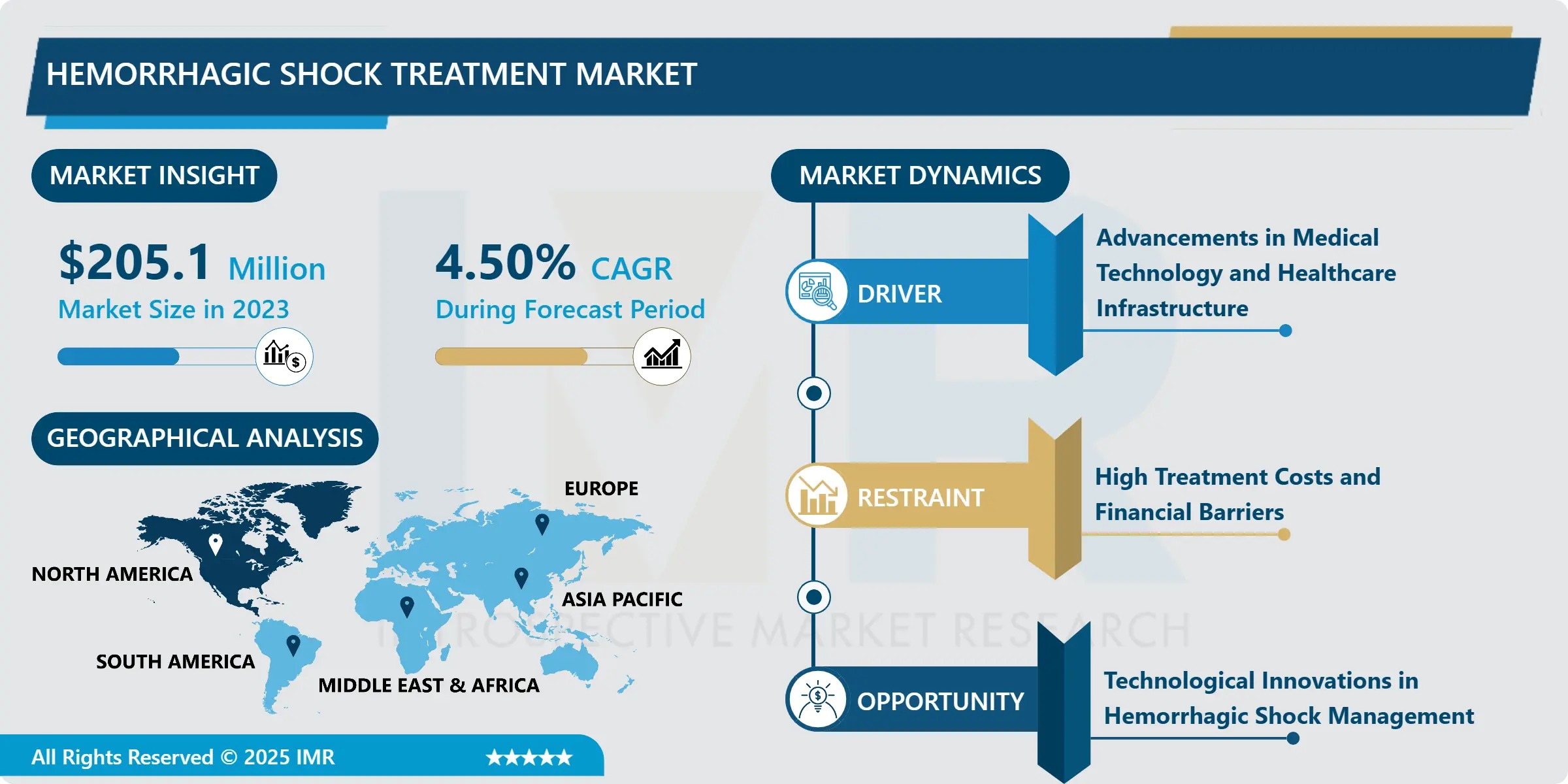
The Hemorrhagic Shock Treatment Market valued at USD 205.1 Million in 2023, is projected to expand to USD 304.8 Million by 2032, demonstrating a Compound Annual Growth Rate (CAGR) of 4.5% over the forecast period (2024-2032). The steady expansion of the Hemorrhagic Shock Treatment Market is fundamentally fueled by two top-line drivers: the rising global incidence of trauma-related injuries and operative complications that lead to acute blood loss, and the continuous, urgent innovation in clinical guidelines favoring immediate and effective hemostatic resuscitation. As global trauma centers-particularly in North America-adopt advanced protocols that prioritize blood products and novel pharmacological agents over simple crystalloids, the demand for highly specialized and rapid-acting hemorrhagic shock treatments is accelerating across the critical care landscape.
Quick Insights: Hemorrhagic Shock Treatment Market (2024-2032)
| Data Point | Insight |
| Market Value (2023) | USD 205.1 Million |
| Projected Value (2032) | USD 304.8 Million |
| CAGR (2024-2032) | 4.5% |
| Dominant Segment (Product) | Drug Type / IV Fluids & Blood Products (Core of resuscitation) |
| Largest End-User | Hospitals (Trauma and Emergency Centers) |
| Leading Regional Market | North America (Advanced Trauma Care Systems) |
| Fastest Growing Region | Asia-Pacific (Improving Emergency Healthcare Access) |
| Key Market Driver | Rising Global Incidence of Trauma-Related Fatalities |
| Primary Restraint | High Cost and Regulatory Hurdles for Novel Blood Substitutes |
| Key Players Focus | Rapid Intervention Therapies and Advanced Diagnostics |
Hemorrhagic Shock Treatment Market Revenue Breakdown (USD Million)
| Metric | 2023 | 2032 (Projected) |
| Global Market Value | $205.1 | $304.8 |
| Projected Revenue Increase | N/A | $99.7 Million (Incremental Growth) |
(Note: Specific revenue distribution across drug types and distribution channels is detailed in the full report.)
How Are Technological Advancements Redefining Emergency and Trauma Care?
The treatment of massive hemorrhage has traditionally relied on rapid fluid and blood replacement. The primary opportunities and trends now lie in the development of next-generation solutions that are more targeted and sustainable.
The most compelling opportunity is the advancement of Novel Resuscitation Fluids and Blood Substitutes. Companies are heavily investing in oxygen-carrying solutions and synthetic blood substitutes that can be stored for long periods, administered universally (without type matching), and rapidly transported to battlefield or remote trauma sites. Furthermore, the integration of AI-Supported Diagnostics is emerging as a critical trend. AI systems capable of triaging non-contrast CT scans and identifying intracranial hemorrhage rapidly are improving intervention precision, leading to faster treatment initiation-a crucial factor in surviving hemorrhagic shock.
Expert Perspective on the Paradigm Shift in Trauma Resuscitation
“The clinical environment for managing severe bleeding is undergoing a profound paradigm shift-we are moving away from permissive hypotension and crystal-clear IV fluids toward Damage Control Resuscitation protocols,” states Dr. Julian Chen, Principal Consultant in Critical Care at Introspective Market Research. “This means pushing for the early and balanced use of blood products-Red Blood Cells, Plasma, and Platelets in a 1:1:1 ratio-and introducing sophisticated hemostatic agents. The drug type segment, specifically novel pharmacological agents like NVX-408 and LB-1148, is vital because they work at the cellular level to mitigate reperfusion damage, significantly boosting patient tolerance for acute blood loss and improving survival rates in critical care.”
Regional and Segmentation Analysis: A Global Fight Against Fatal Bleeding
Segmentation Analysis: Focus on Drug Efficacy
The Drug Type segment, which includes novel agents like the anti-shock therapies and the core components of resuscitation (Intravenous Fluids and Blood Products), is projected to maintain the market’s largest share. This dominance underscores the indispensable role of both volume replacement and pharmacological stabilization in emergency settings. The primary End-User segment, Hospitals and advanced trauma centers, naturally dominates the market due to the specialized equipment and blood bank capabilities required for rapid, massive transfusion protocols.
Regional Analysis: North America Leads the Standard of Care
North America is confirmed as the dominant regional market, accounting for a significant share. This leadership position is secured by its highly organized trauma care systems, continuous governmental and private funding for R&D in critical care, and the rapid adoption of latest clinical guidelines and FDA-approved treatments.
Asia-Pacific (APAC) region is expected to register the fastest growth rate. This rapid growth is fueled by increasing healthcare expenditure, massive governmental investments in upgrading emergency medical services, and the establishment of new trauma centers across developing economies like China and India, creating substantial new demand for modern hemorrhagic shock treatments.
Corporate Strategies, Latest Breakthroughs, and Cost-Benefit Analysis
Leading global pharmaceutical and medical device companies, including Pfizer Inc., Viatris Inc., Baxter Inc., and Merck & Co., Inc., are prioritizing product development that focuses on portability, shelf-life extension, and ease of use in high-stress, low-resource environments.
Latest Breakthroughs, Cost-Efficiency, and Core Benefits:
Non-Pneumatic Anti-Shock Garments (NASG): Although a device-based intervention, the adoption of NASGs in low-resource settings, particularly for conditions like Postpartum Hemorrhage, represents a cost-effective, immediate solution to stabilize patients while awaiting full medical treatment.
Targeted Complement Inhibition: Research into anti-shock therapies that mitigate damage caused by ischemia and reperfusion-such as C1-esterase inhibitors-show promise for reducing secondary organ injury following initial stabilization.
Cost-Efficiency and Clinical Benefits: While the innovative drugs and complex blood products used in hemostatic resuscitation are highly priced, their cost is easily justified by the massive benefit: preventing mortality and severe long-term disability. Hemorrhagic shock is a race against time; effective, rapid treatment, though initially expensive, drastically lowers the cost of long-term care, intensive care unit (ICU) stays, and the economic burden of permanent disability, proving to be the most cost-effective approach to trauma management. The core benefit is the preservation of life and minimizing secondary organ failure.
About Introspective Market Research
Introspective Market Research(IMR) is a visionary research company that provides clients with both customized and syndicated solutions for global market reports. We offer comprehensive, in-depth studies across numerous industry verticals, covering a range of strategic insights, market forecasts, competitive intelligence, and growth opportunities that enable our clients to achieve their business objectives. Our mission is to empower decision-makers with the precise and actionable data they need to navigate complex market environments
Take the Next Step: Optimize Your Emergency Care Strategy
To gain a detailed competitive analysis, revenue share data, and in-depth profiles of the industry’s key players, download a complimentary sample of the Hemorrhagic Shock Treatment Market Report today.
[https://introspectivemarketresearch.com/request/20144]
Contact Information
Introspective Market Research
Phone: +91-91753-37569.
Email: info@introspectivemarketresearch.com
Web: Introspective Market Research Website