



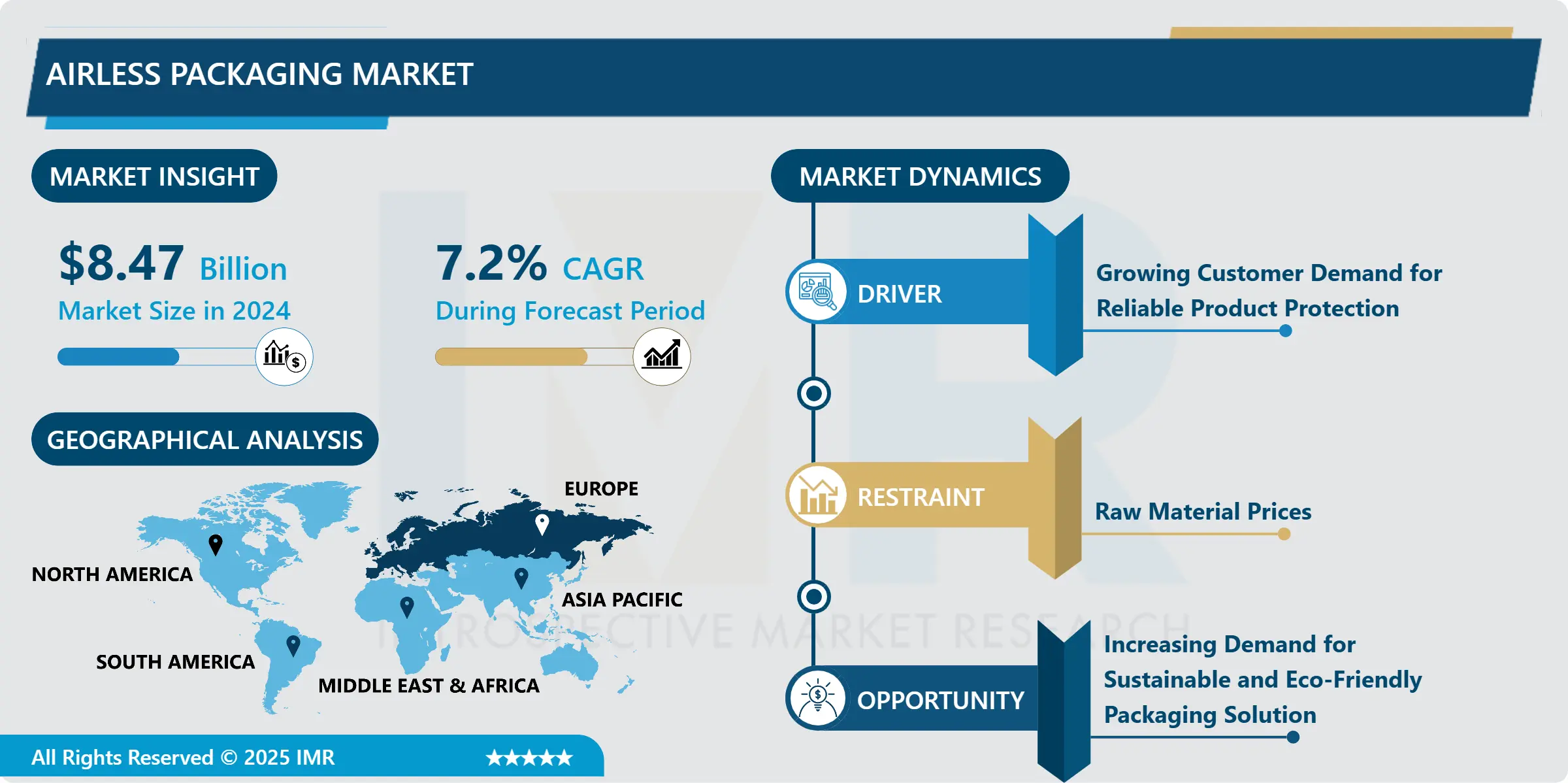
The airless packaging market size was reached USD 8.47 billion in 2024 and is redicted to be worth around USD 18.20 billion by 2035, growing at a CAGR of 7.2% From 2025-2035.
The growth is being fueled by increasing consumer awareness around product preservation, rising demand for luxury and natural personal care formulations, and a push toward sustainable, refillable packaging formats.
Airless packaging systems — designed to prevent air ingress and thereby preserve fragile formulations — are becoming increasingly favored by brands in cosmetics, pharmaceuticals, and homecare. With innovations in materials, smart dispensing, and sustainability, the market is entering a dynamic growth phase.
Quick Insights
- 2023 Market Size (Base Year): USD 7,997.63 million
- 2032 Forecast: USD 14,715.69 million
- Forecast Period CAGR: 7.01% (2024–2032)
- Top Material Segment: Plastic (PP, PET, PE)
- Leading End-User: Personal Care & Cosmetics
- Key Companies: AptarGroup, Albea S.A., HCP Packaging, Silgan Dispensing Systems, Lumson S.p.A.
- Primary Regional Markets: North America, Western Europe, Asia-Pacific
- Major Opportunity: Shift toward sustainable bio-based packaging materials
- Critical Restraint: Volatility in raw material pricing
Market Dynamics: What’s Driving Growth
Airless packaging’s hallmark is its airtight dispensing system, protecting sensitive formulations from oxidation, microbial contamination, and degradation. This feature is particularly valuable for premium skincare products such as serums, retinoids, and natural cosmetics, where preserving actives is critical.
Beyond formulation protection, brands are increasingly using airless systems as a differentiator: the sleek design, precise dosing, and perceived luxury help build brand loyalty. Sustainability concerns are also pivotal—consumers and regulators alike are pushing for recyclable or refillable materials; advances in bio-based plastics are making airless packaging more eco-friendly.
E-commerce further amplifies the need for leak-proof, contamination-resistant systems, since airless packaging helps ensure product integrity during transit.
What’s Next? Key Opportunities & Trends
Q: Where is the biggest opportunity in the next five years?
- Sustainability & Bio-Based Packaging: The rising consumer demand for eco-conscious products and strict regulatory frameworks are pushing manufacturers to adopt recyclable plastics or bio-based materials for airless packaging.
- Smart & Connected Packaging: Integration of QR codes and RFID tags enables traceability, personalized consumer engagement, and better inventory control.
- Refill Models: As refillable formats gain traction, brands can tap into circular economy principles to reduce waste and improve customer retention.
Expert Comment
“With the airless packaging market on track to nearly double by 2032, we are witnessing a convergence of premiumization, sustainability, and smart innovation,” said Dr. Priya Menon, Principal Consultant at .
“Brands that invest in bio-based materials and modular, connected dispensers will not only meet regulatory and environmental expectations but also unlock deeper consumer engagement.”
Regional & Segment Analysis
Material Insights
Plastic continues to dominate the global airless packaging landscape, accounting for the highest market share in 2023. Its widespread adoption is driven by a combination of cost efficiency, superior moldability, and lightweight characteristics, making it ideal for mass-market and premium products alike. Polypropylene (PP), PET, and polyethylene (PE) remain the most preferred polymers due to their durability, compatibility with viscous formulations, and ability to support a wide range of dispenser designs. Plastic’s versatility also enables brand differentiation through custom colors, shapes, and decoration techniques—an essential advantage in the hyper-competitive beauty and wellness sectors.
In contrast, bio-based and sustainable materials are emerging as the fastest-growing category, reflecting rising consumer expectations around environmental stewardship. These materials offer reduced carbon footprint and improved circularity, making them particularly attractive to natural skincare, cosmeceutical, and organic wellness brands. As regulatory bodies tighten restrictions on single-use plastics, demand for biodegradable or mono-material airless systems will accelerate. Manufacturers are actively investing in new bio-polymers and compostable resin solutions to meet this shift.
While smaller in volume, glass and metal airless packaging formats occupy a strategic niche. These materials cater primarily to luxury, prestige, and clinical-grade brands seeking a premium aesthetic, enhanced barrier protection, and a high-end sensory experience. Glass airless bottles offer a weighty, eco-conscious alternative to plastic, while metal dispensers deliver advanced durability and product stability. This segment, though limited, is gaining relevance among brands looking to elevate perceived value and stand out in saturated markets.
End-User Insights
The personal care and cosmetics sector solidified its position as the largest end-use market in 2023, propelled by the rise of premium skincare, clean beauty, anti-aging formulations, and high-potency serums. Airless systems are ideal for protecting active ingredients such as retinoids, vitamin C, hyaluronic acid, and botanical extracts, which degrade quickly upon exposure to air and microbes. The surge in indie beauty brands and D2C models has further fueled adoption, as smaller brands use airless systems to build trust and emphasize product purity.
The healthcare and pharmaceutical segment is expanding rapidly, driven by the need for precise dosing, sterile dispensing, and contamination-free delivery of topical medications, dermatological creams, and specialty therapeutic formulations. With rising demand for prescription skincare and OTC medical-grade products, more pharmaceutical companies are turning to airless technology to ensure stability, shelf life, and patient safety.
Meanwhile, the food & beverage and homecare categories, though comparatively smaller, are emerging as new opportunity zones. Airless packaging is being adopted for gourmet syrups, functional ingredients, and concentrated solutions where precision dispensing, oxidation prevention, and extended freshness are critical. In homecare, its role is growing in segments such as natural cleaning solutions and specialty surface care products.
Distribution Channel Insights
E-commerce has become a pivotal distribution channel, particularly in the post-pandemic retail landscape. With products traveling long distances and facing unpredictable handling conditions, brands favor airless formats for their leak-proof, tamper-resistant, and travel-resilient properties. This shift is especially relevant for skincare, wellness, and pharmaceutical brands that require high packaging integrity to maintain consumer trust and avoid damage-related returns
On the other hand, specialty stores and premium retail outlets continue to champion airless packaging, especially in the beauty and wellness segments where shelf appeal and tactile experiences influence consumer decision-making. Airless bottles, jars, and dispensers offer a sleek, elevated appearance that aligns with the expectations of high-end shoppers, making them a natural fit for luxury counters, spas, and boutique beauty chains.
Region Inights
North America remains a dominant regional market, supported by a strong ecosystem of packaging innovators, advanced manufacturing capabilities, and stringent regulatory frameworks that prioritize product safety and sustainability. The presence of leading skincare, pharmaceutical, and premium beauty brands further cements the region’s leadership in adopting next-generation airless technologies.
Western Europe continues to be an innovation hub, driven largely by strict environmental regulations and an early shift toward clean beauty. European brands are among the first to adopt recyclable, refillable, and mono-material airless systems, pushing manufacturers to accelerate R&D in eco-friendly designs. This region’s emphasis on premium skincare and dermo-cosmetics also contributes to strong demand for glass and high-end hybrid formats.
Asia-Pacific stands out as the fastest-growing market, powered by rising disposable incomes, rapid urbanization, and the booming cosmetics industries in China, South Korea, Japan, and India. The region’s consumers show strong preference for innovative, hygienic, and precision-dispensing formats, especially in K-beauty and J-beauty routines. Increasing regulatory focus on sustainable packaging solutions is also encouraging regional manufacturers to adopt bio-materials and refill systems.
Innovation Spotlights & Breakthroughs
Several companies in the airless packaging space are making notable strides:
- AptarGroup (USA) continues pushing boundaries with its precision pump platforms, particularly for pharmaceutical and skincare applications. +1
- Albea S.A. (France) leverages vertical integration—from resin to decoration—to accelerate customized launches for indie and prestige beauty labels.
- Lumson S.p.A. (Italy) is developing hybrid systems that combine rigid outer bottles with flexible inner bags (“bag-in-bottle”), reducing waste and improving product evacuation.
These innovations not only solve for functionality and cost but also respond to the growing consumer and regulatory focus on sustainability.
Challenges & Cost Pressures
Despite the bullish outlook, the airless packaging market faces several headwinds:
- Raw material price volatility: Plastic resins (especially specialty polymers) remain subject to global supply chain fluctuations, driving up costs.
- Complex manufacturing: Precisely engineered airless systems (e.g., pumps, diaphragms) often require multi-stage assembly, which adds to production cost.
- Recycling and end-of-life: While bio-based and mono-material systems are gaining ground, the infrastructure to recycle or compost these materials at scale is not yet mature in many regions.
- Adoption resistance in lower-cost markets: For mass or budget segments, the premium price of airless systems remains a barrier.
Case Study Highlight
Case Study – Dermanova Skincare Launch
Dermanova, a mid-sized clean-beauty brand, recently launched a new line of vitamin C serums packaged in a dual-chamber airless bottle developed in partnership with a leading converter. By using the airless system, the brand maintained the potency of its active formulas, extended shelf life by 30%, and reduced preservative load — leading to a 25% boost in repeat purchases within the first six months. Dermanova also introduced a refill model: customers return the inner pouches for recycling, aligning with their sustainability mission and reducing cost per unit for the brand.
Media Contact
Phone: +91-74101-03736 / +91-95790-51919 I
Email: sales@introspectivemarketresearch.com
Website: introspectivemarketresearch.com