





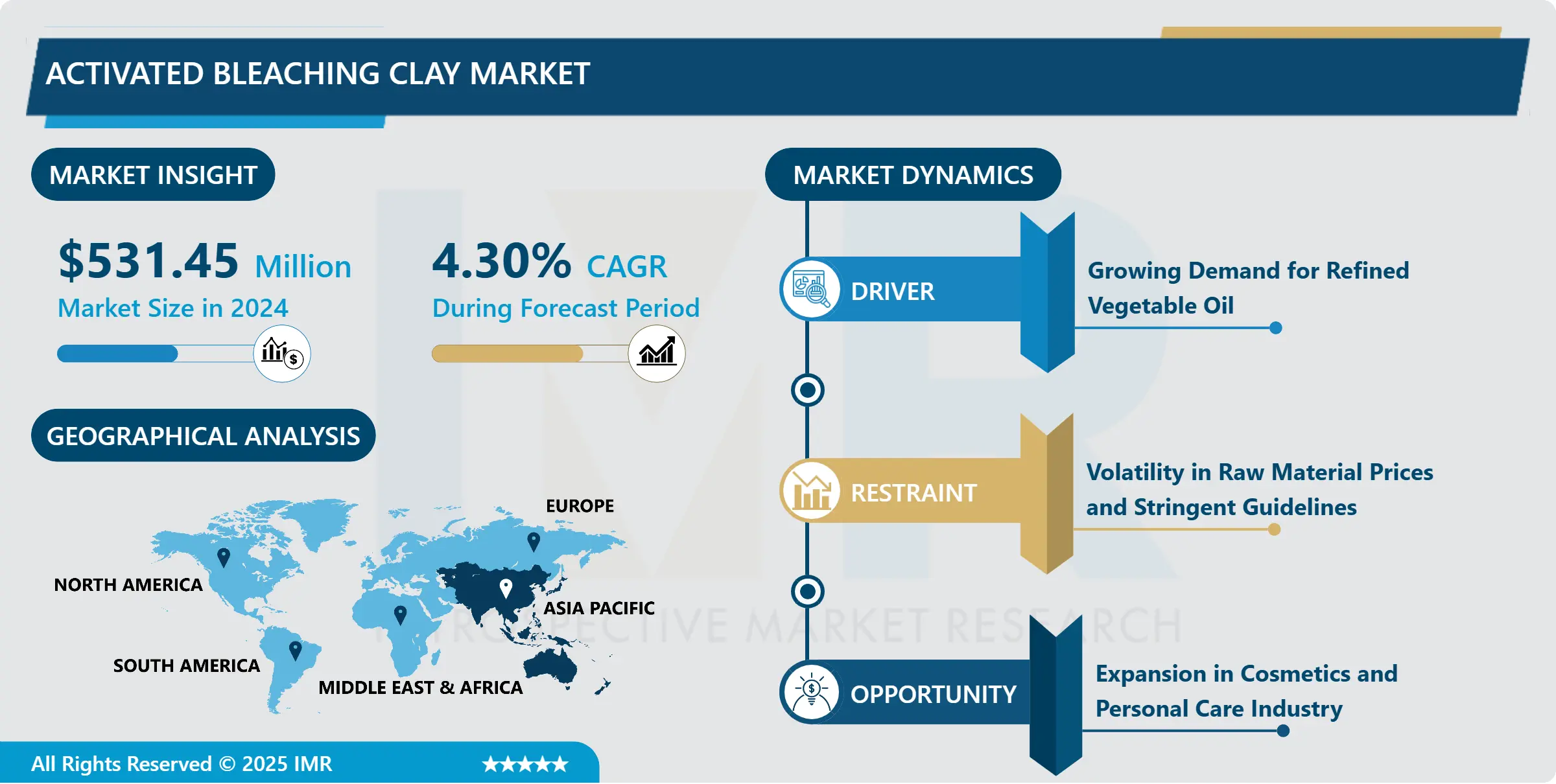
The global activated bleaching clay market reached USD 531.45 million in 2024 and is projected to expand to USD 844.48 million by 2035, reflecting a CAGR of 4.30% (2025–2035). This strong growth is driven by rising consumption of purified vegetable and mineral oils, stricter environmental regulations, and increasing adoption of greener purification technologies.
Quick Insights
- 2024 Market Size: USD 531.45 million
- 2035 Forecast: USD 844.48 million (CAGR 4.3%)
- Top Application (2024): Edible oils & fats refining (77.22%)
- Leading Type: Natural bleaching clay
- Fastest-Growing Region: Asia-Pacific
- Key Players: Oil-Dri Corporation of America, EP Minerals, Mineral Technologies Inc., Clariant, Ashapura Group, Musim Mas, Taiko Group, and more
Why the Market Is Growing
According to IMR, global demand for refined vegetable oils remains the single most influential factor shaping market expansion. As oil-rich diets rise in developing economies and industrial food processing accelerates, manufacturers are increasingly relying on activated bleaching clay to eliminate pigments, free fatty acids, and impurities—enhancing oil quality, stability, and shelf life.
At the same time, sustainability trends are pushing industries toward natural, eco-friendly purification media. Activated bleaching clay, especially naturally sourced variants, offers an economical and environmentally responsible alternative to synthetic adsorbents.
Where Innovation Is Happening
The circular economy is creating new momentum for activated bleaching clay. Rapid growth in waste oil recycling and re-refining—driven by stricter environmental guidelines—is unlocking fresh opportunities. The clay’s high adsorption efficiency makes it ideal for recovering and purifying used lubricants and transformer oils.
The cosmetics and personal care industry is also emerging as a strong growth vertical. As “clean beauty” formulations gain traction, naturally sourced bleaching clays are being used to purify plant oils, waxes, and active ingredients while meeting sustainability expectations.
Expert Insight
“Activated bleaching clay is no longer just a refining agent—it is becoming a core enabler of industrial sustainability,” said Dr. Nina Deshpande, Principal Consultant. “With rising regulatory pressures and the shift toward circularity, advanced clay technologies will play a pivotal role in purification and recycling value chains.”
Regional & Segmentation Landscape
Asia-Pacific
Asia-Pacific continues to be the fastest-growing region, fueled by booming food processing, edible oil refining, and specialty chemical industries. Countries like China, India, Indonesia, and Malaysia have witnessed a sharp rise in refined vegetable oil consumption, directly increasing demand for bleaching clay. The region’s expanding cosmetics sector—particularly natural and mineral-based skincare—further supports market growth. Abundant bentonite deposits in China and India also ensure cost-efficient production, reinforcing APAC’s position as the global growth engine.
North America & Europe
North America and Europe remain stable, mature markets that rely heavily on high-quality bleaching clay for specialty refining, lubricants purification, and environmental cleanup applications. Strong regulatory frameworks, sustainability commitments, and premium edible oil standards support consistent demand. Europe’s advanced cosmetic manufacturers are adopting natural clays to meet clean-label expectations, while North America continues to lead in transformer oil recycling and mineral oil purification.
Type Analysis
Natural bleaching clay maintains dominance due to its cost-effectiveness and suitability for standard edible oil refining. However, acid-activated and bentonite-based clays are gaining momentum in high-performance applications requiring stronger adsorption, lower oil retention, and enhanced impurity removal. Acid-activated variants are particularly favored in operations with stringent color and quality requirements, while bentonite-based clays benefit from growing demand for naturally sourced, sustainable materials.
Application Analysis
The edible oils & fats refining segment remains the largest application, driven by high consumption of soybean, palm, sunflower, groundnut, and rapeseed oils. Beyond this, mineral oils and wax refining form another key cluster, supported by demand in lubricants, petrochemicals, and industrial maintenance. Specialized clays are also used in purifying paraffin waxes for cosmetics, packaging, pharmaceuticals, and candle production—underscoring the market’s diverse industrial relevance.
End-User Analysis
The Food & Beverage sector leads in consumption, followed by strong growth in Cosmetics & Personal Care, where bleaching clays purify oils and natural ingredients for creams, balms, and haircare products. The Chemicals industry also plays a major role, employing these clays in transformer oil regeneration, grease production, and waste oil recycling, all of which expand the market’s application breadth.
Innovations & Industry Moves
Recent developments identified by IMR include:
- Oil-Dri Corporation of America: Acquired Ultra Pet Company (May 2024) to strengthen diversification and supply chain control.
- Mineral Technologies Inc.: Partnered with a global paper company to introduce NewYield® LO PCC technology—transforming waste into value-added filler pigments.
- Clariant and others: Advancing eco-friendly activation processes and lower oil retention formulations to meet rising sustainability expectations.
Challenges & Risk Factors
The market’s growth is tempered by several challenges:
- Volatile raw material prices: Extraction costs for bentonite and other clay feedstocks can fluctuate.
- Regulatory complexity: Food and pharmaceutical applications require stringent compliance.
- High processing costs: Heat and acid activation processes demand energy, raising production costs for sustainable variants.
Real-World Case Insight
A leading refinery in Southeast Asia adopted a regionally sourced natural bleaching clay activated through a low-acid process. This transition resulted in reduced oil retention, improved purification efficiency, and lower environmental impact—enhancing cost performance while supporting long-term sustainability goals.
Call to Action
For the full Activated Bleaching Clay Market report, request a sample or schedule a detailed analyst discussion.
Request Sample / Meeting
About IMR
Introspective Market Research (IMR) is a global market intelligence firm headquartered in Pune, India. We deliver actionable insights across Chemicals, Food & Beverage, Healthcare, Agriculture, and Technology sectors.
Contact:
IMR Sales Team
📞 +91-74101-03736 | +91-81800-96367
📧 sales@introspectivemarketresearch.com
🌐 www.introspectivemarketresearch.com