






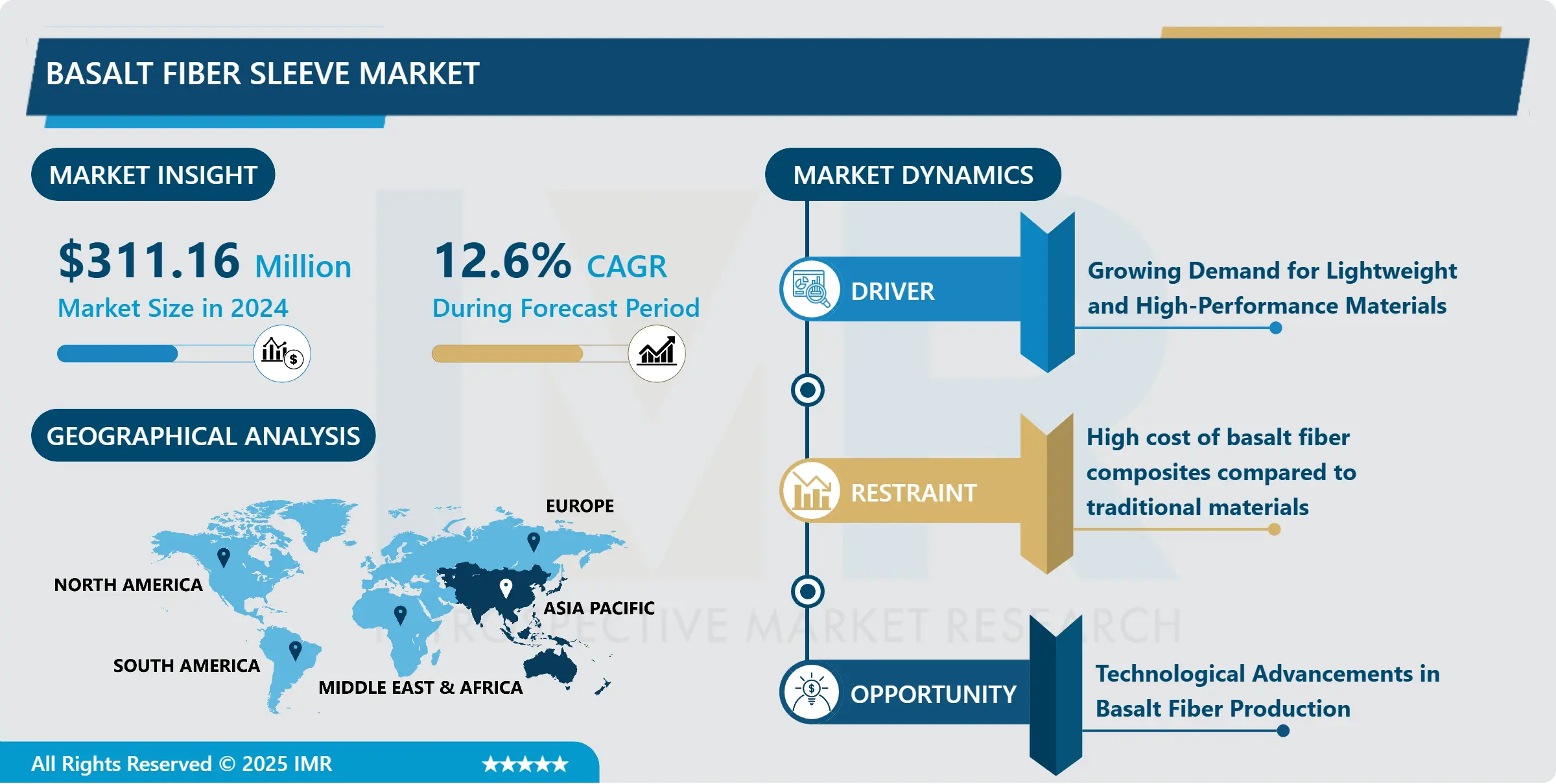
The basalt fiber sleeve market Size reached USD 311.16 million in 2024 and is predicted to be worth around USD 1147.91 million by 2035, growing at a CAGR of 12.6% from 2025 to 2035.
Basalt fiber sleeves tubular structures made from volcanic basalt rock are increasingly being adopted across industrial verticals for their exceptional thermal resistance, mechanical strength, durability, and corrosion resistance. These properties make them especially valuable in environments exposed to extreme heat, abrasion, or chemical stress. The accelerating global demand is being propelled by rapid industrialization, supply-chain shifts, and a rising push toward sustainable, lightweight materials.
Quick Insights
- 2023 Market Size: USD 276.34 million
- 2032 Forecast: USD 801.49 million
- Forecast CAGR (2024–2032): 12.56%
- Dominant Region: Asia-Pacific, driven by infrastructure growth and raw-material access
- Leading Temperature Segment: Sleeves rated for 700 °C maximum continuous temperature
- Key Applications: Household electrical appliances; fluid transportation piping; automotive; metallurgy; chemical industries
- Top Players: Refractory Specialties, Morgan Advanced Materials, Pyrotek, Owens Corning, Saint-Gobain, 3M, Technobasalt Invest, Basalt Fiber India, among others
What’s Driving Growth — and What’s Holding It Back?
What’s Fueling the Surge?
- Lightweight, high-performance demand: Industries like aerospace, automotive, and construction are increasingly prioritizing materials that combine strength with weight savings – a core advantage of basalt fiber sleeves.
- Sustainability: Basalt is derived from natural volcanic rock, making it an eco-friendlier alternative to traditional materials like fiberglass.
- Technological advances: Improvements in basalt fiber manufacturing — such as optimized melt-spinning processes and fine-tuning of fiber geometry — are making sleeves more cost-efficient and customizable.
Challenges & Cost Pressures
- High production costs: The advanced processing required for basalt fibers still makes sleeves more expensive compared to legacy insulators or reinforcements.
- Market education & adoption barriers: Some end users remain cautious due to limited familiarity with basalt-based solutions and uncertain performance in large-scale deployments.
- Supply chain complexity: Securing high-purity basalt, ensuring consistent fiber quality, and managing energy-intensive production remain operational challenges.
So, What’s the Big Opportunity?
Could ongoing innovations in basalt fiber production unlock new verticals?
As production techniques mature, manufacturers are gaining flexibility to tailor fiber properties (e.g., diameter, strength, thermal tolerance), unlocking use cases in increasingly demanding sectors — from petrochemicals and metallurgy to aerospace composites.
Could basalt sleeves become a mainstream solution for thermal insulation in future green infrastructure?
With sustainability gaining ground, basalt sleeves may challenge or even replace conventional insulation materials in next-generation clean-energy plants, electric vehicles, and smart industrial systems.
Regional & Segmentation Analysis
Asia-Pacific: The Undisputed Growth Engine
Asia-Pacific continues to command the largest share of the basalt fiber sleeve market, supported by rapid industrialization, extensive manufacturing bases, and robust infrastructure development. Countries such as China, India, Japan, and South Korea are scaling up their consumption of high-performance insulation and protection materials as they expand automotive production, aerospace component manufacturing, metallurgical processing, and energy systems engineering.
China remains the global epicenter for basalt fiber production due to abundant basalt resources and cost-efficient manufacturing capabilities. Indian producers are also gaining traction, with increasing government emphasis on renewable energy infrastructure, electric vehicle (EV) adoption, and modernization of industrial plants. Meanwhile, Southeast Asian economies—including Indonesia, Vietnam, and Thailand—are emerging as new demand pockets for basalt sleeves, driven by electronics production, battery manufacturing, and expanding industrial corridors.
Additionally, Asia-Pacific’s growing focus on sustainability and lightweight composite materials is accelerating the transition from conventional fiberglass or ceramic insulation toward eco-friendly basalt-based solutions. The region is expected to maintain its leadership through 2032, backed by favorable policy frameworks, innovation clusters, and strong OEM demand.
Temperature-Based Segmentation: 700 °C Category Leads the Pack
Within the temperature-rating segment, basalt fiber sleeves designed for continuous exposure up to 700 °C dominate the market. This segment strikes an optimal balance between thermal endurance, cost-efficiency, and mechanical performance, making it the preferred choice across a broad spectrum of heavy-duty industries.
In aerospace and automotive manufacturing, these sleeves are used to shield wiring harnesses, fuel lines, and exhaust components from extreme heat. Their unparalleled ability to maintain structural integrity under prolonged thermal stress also makes them indispensable in petrochemical refineries, metal smelting operations, and power plants—where equipment is routinely exposed to high temperatures, corrosive environments, and abrasive conditions.
As a result, the 700 °C category not only holds the largest share today but is also increasingly becoming the industry standard for next-generation insulation applications. Growing R&D investments in advanced basalt melt technologies and fiber optimization are further strengthening this segment’s outlook.
Application Segmentation: From Thermal Insulation to Advanced Protection Systems
The application landscape for basalt fiber sleeves is rapidly broadening. While traditionally used for thermal insulation of pipes, exhaust systems, and industrial engines, their usage is expanding into more specialized and mission-critical applications.
A major area of growth is in mechanical protection for cables, hoses, and hydraulic lines across industries such as robotics, manufacturing automation, mining, marine operations, and heavy engineering. Their inherent abrasion resistance, dielectric strength, anti-corrosion properties, and chemical stability make them ideally suited for harsh industrial environments where traditional materials degrade quickly.
Additionally, basalt sleeves are increasingly being adopted in:
Electric vehicles (EVs) for battery cable protection
Wind turbine systems to safeguard mechanical assemblies
Oil & gas operations for protecting flexible pipes and risers
Electronics manufacturing where high-temperature cable routing is required
Construction and smart infrastructure as reinforcement and insulation layers
As industries become more reliability-focused and safety-driven, the demand for multifunctional protective sleeves—capable of handling both thermal and mechanical stress—is expected to soar. This is where basalt fiber sleeves are emerging as a superior alternative, outperforming legacy fiberglass, ceramic fiber, and polymer-based solutions.
Innovation & Breakthroughs
Several major players are pushing the envelope:
- Technobasalt Invest (Ukraine) and Basalt Fiber India are scaling up advanced production operations with higher temperature rating sleeves.
- Saint-Gobain and 3M are focusing on tailored fiber-sleeve systems for automotive and aerospace OEMs, optimizing for both strength and weight.
- Morgan Advanced Materials is reportedly integrating basalt sleeves into next-gen composite tanks and pipes to replace heavier metallic counterparts.
Expert Commentary
“Basalt fiber sleeves have arrived at a critical inflection point,” says Dr. Aisha Mehta, Principal Consultant, . “With both the materials science and manufacturing processes maturing, we’re now seeing these solutions migrate from niche high-temperature applications into mainstream industrial use. The 12.5% CAGR we project is not just about insulation — it’s about a broader material shift toward sustainable, robust, and lightweight designs.”
A Case in Point
In one notable application, a global petrochemical company replaced conventional fiberglass insulation on its high-temperature piping with basalt fiber sleeves. The result: a 15% reduction in thermal losses, significantly improved durability, and lower maintenance costs. According to our analysis, such case studies could soon become more common as industry players validate the long-term ROI of basalt-based systems.