




The butyl lactate market size was valued at USD 0.89 billion in 2024 and is projected to reach USD 1.89 billion by 2035, growing at a CAGR of 7.1% from 2025 to 2035.
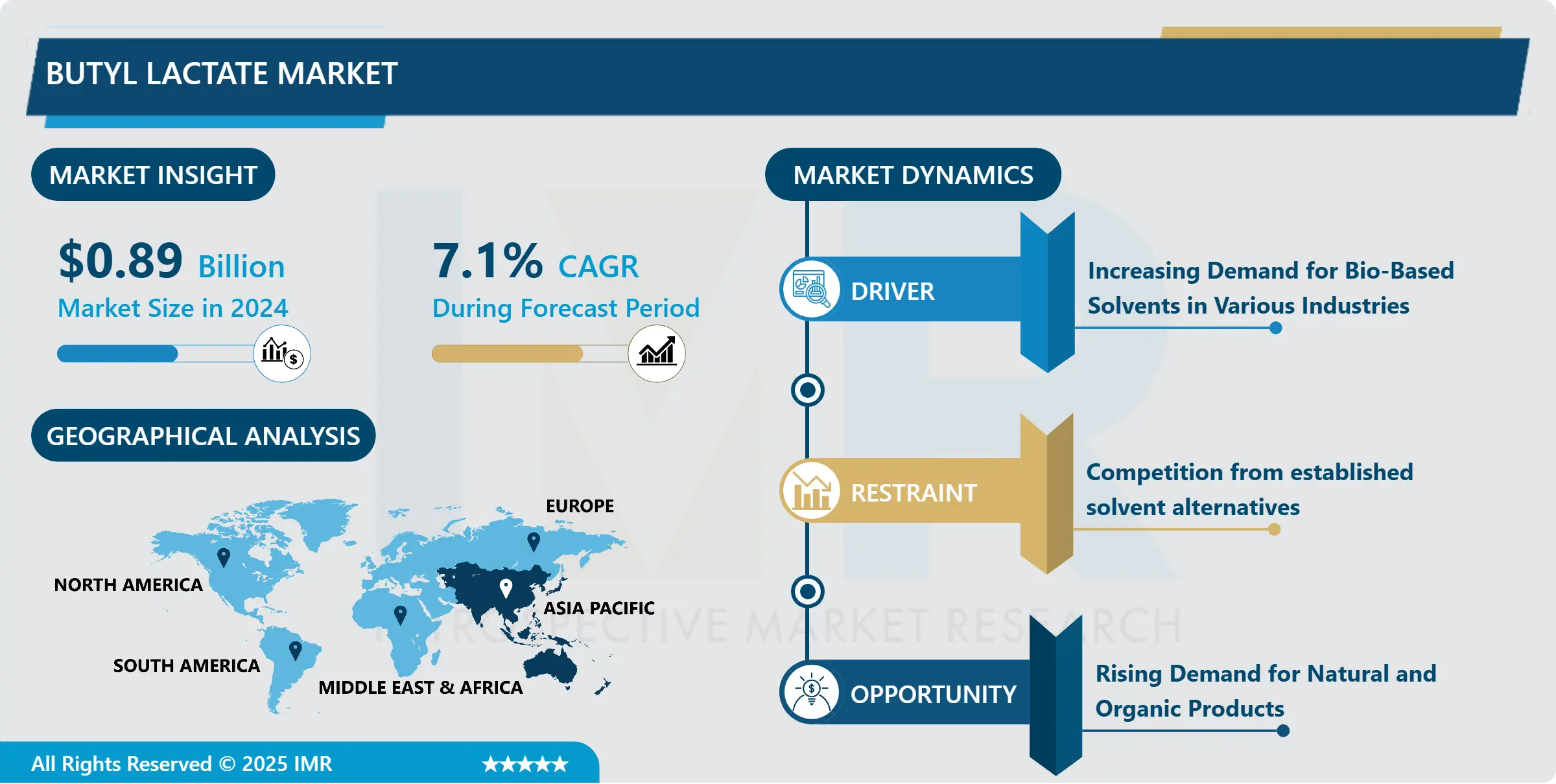
Fueled by increasing demand for bio-based solvents, tighter environmental regulations, and surging consumption in consumer- and industrial-grade applications, butyl lactate is rapidly becoming a preferred alternative to traditional petroleum-derived solvents.
Quick Insights
- 2023 Market Size: USD 0.83 Bn
- Forecast 2032: USD 1.52 Bn
- Projected CAGR (2024–2032): ~6.98%
- Dominant Grade: Food-grade butyl lactate leads, driven by food additive and flavoring demand
- Top Application Verticals: Agrochemicals; Cosmetics & Personal Care; Electronics
- Leading Region: Asia Pacific, due to booming manufacturing and eco-product demand
- Major Players: Dow Chemical, Eastman, Vertellus, IFF, BASF, Advanced Biotech, Prinova, BOC Sciences, Ventós, Inoue Perfumery, Shaanxi Dideu Medichem, Tokyo Chemical Industry Co., Ltd.
Market Drivers & Introduction
The butyl lactate market is witnessing strong tailwinds as industries increasingly prioritize sustainable chemistry. Its low toxicity, biodegradability, and versatility make butyl lactate a compelling solvent for a broad array of applications, especially in cosmetics, food, pharmaceuticals, and industrial coatings.
As regulatory frameworks tighten around volatile organic compounds (VOCs) and consumers demand greener formulations, butyl lactate’s eco-friendly profile positions it as a solvent of the future. Simultaneously, R&D investments aimed at improving production efficiency and broadening its application base are further accelerating market uptake.
What’s Driving the Opportunity — and Where Are the Trends Heading?
Why is butyl lactate gaining ground so rapidly?
- Sustainability mandate in solvents: Bio-based solvents like butyl lactate align with increasing environmental awareness and regulatory pressure to reduce reliance on traditional petrochemical solvents.
- Consumers pushing for clean-label ingredients: In personal care and food sectors, there is strong demand for safer, natural, and low-toxicity ingredients — a space where food-grade butyl lactate performs strongly.
- Versatile industrial adoption: From agrochemical formulations to coatings and electronics, butyl lactate’s solvency and stability make it broadly useful.
Expert Perspective
“The butyl lactate market is entering a phase of transformation where green chemistry is not just an option, but a competitive imperative,” said Dr. Priya Menon, Principal Consultant, . “Our analysis shows that manufacturers who invest in bio-based capacity and leverage butyl lactate’s clean-profile advantages will be best placed to lead in sustainability-driven end-use sectors.”
Regional Analysis – Asia Pacific
Asia Pacific dominates the global butyl lactate market, supported by robust manufacturing ecosystems in China, India, Japan, and South Korea, where expanding electronics, cosmetics, agrochemicals, and food-processing industries are driving large-scale consumption. The region’s rapid industrialization, competitive production costs, and increasing shift toward bio-based ingredients amplify demand for sustainable solvents like butyl lactate. Additionally, rising consumer preference for eco-friendly personal care and food products in emerging economies, coupled with favorable government initiatives promoting green chemistry, position Asia Pacific as the fastest-growing and largest regional market throughout the forecast period.
Grade Dynamics – Food-Grade Butyl Lactate
Food-grade butyl lactate continues to lead the market due to its critical role as a safe, clean-label ingredient in food processing, flavor enhancement, and food additives. Its low toxicity, biodegradability, and compatibility with global food safety standards make it the preferred choice for manufacturers seeking natural solvent alternatives. As consumer demand intensifies for healthier, transparent ingredient profiles, food-grade variants gain traction in beverages, packaged foods, and flavor formulations. This segment also benefits from expanding R&D efforts to improve purity and stability, ensuring its sustained dominance across industrial and consumer-facing applications.
Application Segment – Agrochemicals
In the agrochemicals segment, butyl lactate is widely used as a high-performance solvent for pesticide, herbicide, and fertilizer formulations, offering superior solubility, controlled evaporation rates, and safer handling properties. Its biodegradable profile aligns with the industry’s transition toward greener crop protection solutions, enabling manufacturers to replace traditional petro-solvents without compromising formulation efficiency. As agricultural modernization accelerates in developing economies and regulatory bodies promote eco-friendly agrochemical inputs, demand for butyl lactate within this segment is expected to grow steadily.
Application Segment – Cosmetics & Personal Care
The cosmetics and personal care industry represents one of the most rapidly expanding application areas, with butyl lactate valued for its mildness, low volatility, and excellent solvent characteristics ideal for nail polish removers, skincare products, hair care items, and fragrance formulations. As consumers increasingly gravitate toward clean beauty products with safer, non-irritating ingredients, butyl lactate’s biodegradable and low-toxicity profile gives it a competitive edge over conventional solvents. Brands leveraging natural-origin formulations and sustainable ingredients continue to elevate demand across global beauty markets.
Application Segment – Electronics
In electronics manufacturing, butyl lactate is utilized in precision cleaning agents, coatings, and surface preparation fluids due to its strong solvency, controlled evaporation behavior, and compatibility with delicate components. Its ability to dissolve organic residues without damaging sensitive circuit surfaces makes it indispensable in semiconductor processing, PCB cleaning, and advanced electronic assembly. With the expansion of consumer electronics, electric vehicles, and semiconductor production across Asia Pacific and North America, the electronics segment is emerging as a high-value, high-growth application area for butyl lactate.
Innovation & Breakthroughs: Who’s Leading?
Key industry players — including Dow Chemical, Eastman, Vertellus, IFF, and BASF — are aggressively investing in butyl lactate capacity and R&D.
- Some companies are exploring bio-fermentation routes to produce butyl lactate from renewable feedstocks, reducing carbon footprints and improving sustainability credentials.
- The cosmetics and food sectors are testing high-purity, food-grade butyl lactate variants, which could unlock even more sensitive application spaces.
Challenges & Cost Pressures
Despite its promise, the butyl lactate market faces several hurdles:
- Raw Material Volatility: Fluctuations in the cost of lactic acid and butanol feedstocks can squeeze margins.
- Competitive Alternatives: Established solvents (petro-based) still compete strongly on price and infrastructure.
- Regulatory Complexity: While bio-based, butyl lactate still must navigate different regional chemical and food-grade regulatory regimes.
- Scaling Bio-Processes: Transitioning from lab-scale fermentation to industrial production demands capital-intensive investments.
Butyl Lactate Market Top Key Players:
- Dow Chemical Company (USA)
- Eastman Chemical Company (USA)
- Vertellus Holdings LLC (USA)
- Vertellus Specialties Inc. (USA)
- IFF (USA)
- Advanced Biotech (USA)
- Prinova (USA)
- BOC Sciences (USA)
- BASF SE (Germany)
- Ventós (Spain)
- Inoue Perfumery (Japan)
- Shaanxi Dideu Medichem (China)
- Tokyo Chemical Industry Co.,