






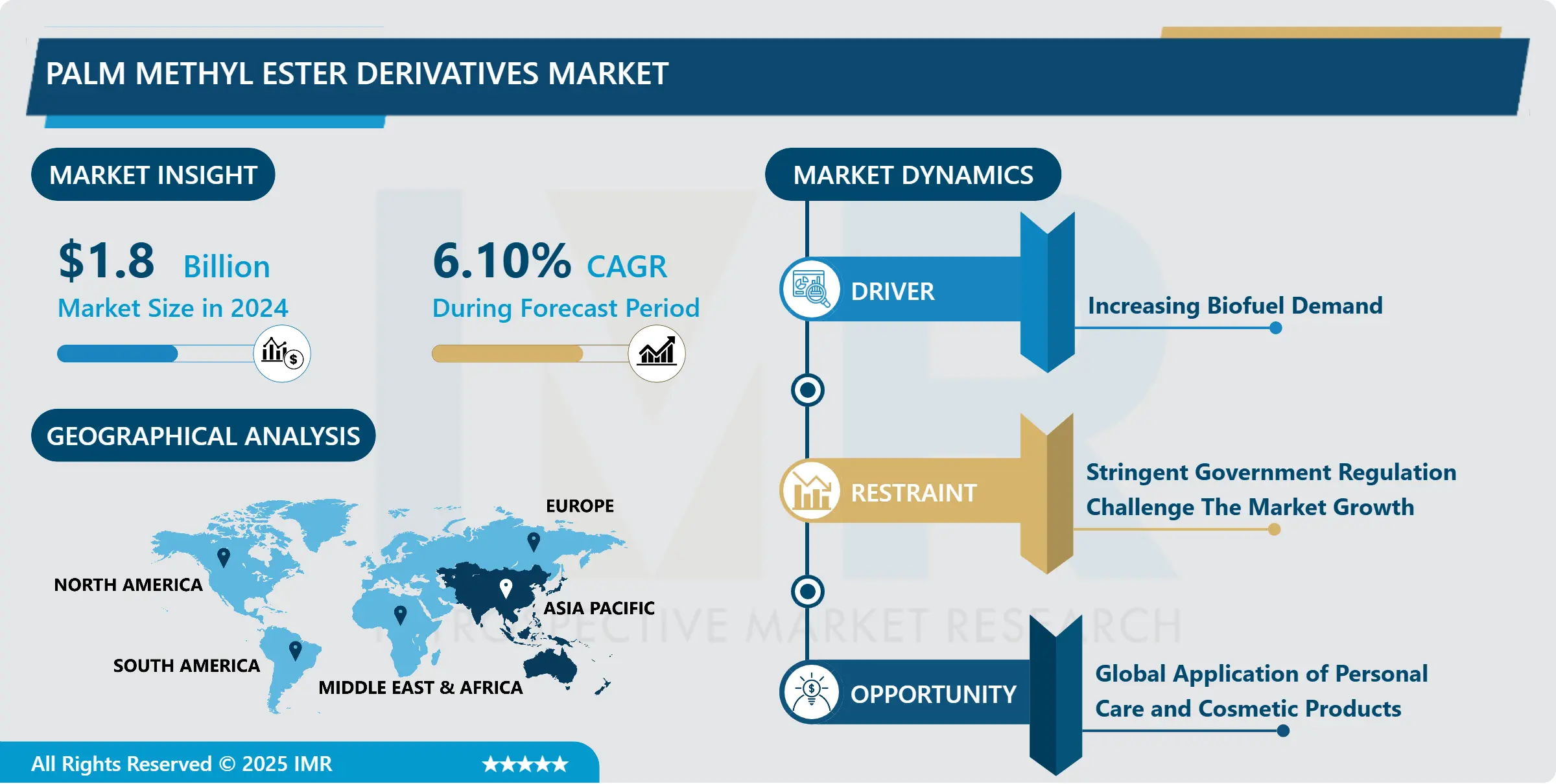
The palm methyl ester derivatives market size was estimated at USD 1.8 billion in 2024 and is predicted to be worth around USD 3.45 billion by 2035, growing at a CAGR of 6.10% from 2025 to 2035.
Introduction
Palm methyl ester derivatives — chemical compounds produced through the esterification of palm oil triglycerides — are gaining unprecedented traction in global markets. Thanks to their biodegradability, non-toxicity, renewability, and excellent emulsifying, lubricating, and solvent properties, PME derivatives are increasingly displacing petrochemical-based alternatives.
IMR’s analysis identifies two primary tailwinds fueling this growth: the push toward renewable energy, particularly biodiesel, and the growing consumer preference for natural, clean-label ingredients in personal care. As governments enact stricter environmental regulations and offer incentives for biofuel adoption, PME-derived biodiesel is becoming a preferred feedstock. Simultaneously, demand for sustainable and skin-friendly ingredients in cosmetics and personal care is rising rapidly.
Quick Insights
- 2024 market size: USD 1.8 billion
- Forecast (2035): USD 3.45 billion
- CAGR (2024–2035): 6.10%
- Dominant region: Asia-Pacific (driven by palm oil production and derivative conversion)
- Largest derivative by type: Methyl Palmitate
- Leading application segment: Biodiesel
- Key players: KLK Oleo, Wilmar International, IOI Group, Emery Oleochemicals, PT Musim Mas, Cargill, BASF, Godrej, Croda, ADM, Azelis, Stepan, P&G Chemicals, VVF, among others
What’s Driving the Growth? — Opportunities & Trends
Why is the PME Derivatives Market poised for such strong expansion?
- Will biofuel mandates continue to propel PME demand?
Governments across Asia, Europe, and Latin America are enacting stricter renewable fuel regulations. Palm methyl ester, with its high cetane number and favorable cold-flow properties, remains a preferred feedstock for biodiesel production. As countries deepen their decarbonization efforts, PME-based biofuels are set to capture a growing share of diesel blending programs. - Can the personal care industry fuel new demand?
Rising consumer awareness around clean beauty is fueling demand for sustainable and biodegradable ingredients in personal care products. PME derivatives, especially methyl palmitate, are being increasingly used as emollients, surfactants, and conditioning agents in soap, shampoo, lotion, and makeup formulations. Their non-toxicity and skin-friendliness make them particularly attractive for green cosmetics. - Is green chemistry entering industrial applications?
Beyond biodiesel and personal care, PME derivatives are making inroads in industrial emulsifiers, lubricants, and solvents. As manufacturers in sectors such as automotive, coatings, and specialty lubricants move toward bio-based alternatives, PME derivatives offer a viable renewable chemistry solution. - What about innovation in production?
Technological breakthroughs — particularly in enzymatic and catalytic processes — are improving yields and purity while lowering the cost and environmental footprint of PME production. Research collaborations are also pushing high-purity derivatives, opening doors to advanced applications in pharmaceuticals, biopolymers, and high-performance materials.
Expert Insight
“Palm methyl ester derivatives are uniquely positioned at the crossroad of sustainability and industrial functionality,” said D. Aruna Singh, Principal Consultant, . “Their versatility across biodiesel, personal care, and green industrial sectors, combined with advances in bio-refining, is setting the stage for a transformation in oleochemical-based value chains. However, the challenge will lie in balancing raw-material sustainability, especially palm oil sourcing, with scale and cost efficiency.”
Regional & Segment Analysis
Asia-Pacific Dominance
The Asia-Pacific region — led by palm oil heavyweights like Malaysia and Indonesia — continues to dominate production and supply of palm methyl esters. The abundance of crude palm oil (CPO) and integrated oleochemical infrastructure gives this region a distinct cost advantage. Meanwhile, rapid industrialization, increasing biodiesel adoption, and growth in personal care consumption further amplify local demand. IMR’s report highlights that Asia-Pacific accounted for a substantial share of the market in recent years and is expected to continue leading.
North America & Europe
Though not palm-oil producing regions, North America and Europe represent important demand centers. These regions are driven by strong regulatory mandates on renewable fuels, consumer demand for bio-based products, and stringent environmental compliance. Europe, in particular, places a high emphasis on sustainability—further driving demand for certified, traceable PME derivatives.
Rest of the World
Emerging markets in Latin America, Middle East, and Africa are also catching up, particularly where biodiesel blending policies or green industrial practices are gaining ground. While feedstock constraints remain, these regions are increasingly becoming players in PME derivative consumption rather than production.
Methyl Palmitate
Methyl Palmitate continues to dominate the type segment in the Palm Methyl Ester Derivatives Market, primarily due to its naturally high availability in crude palm oil (CPO), which contains one of the highest palmitic acid concentrations among global vegetable oil sources. This inherent abundance significantly enhances cost efficiency during downstream processing and conversion of palmitic acids into value-added esters. Methyl Palmitate also benefits from its broad utility across major application clusters, including personal care, food-grade lubricants, surfactants, industrial solvents, and bio-based specialty chemicals. Its excellent oxidative stability, smooth texture, low volatility, and favorable environmental profile give it a competitive edge over petroleum-derived alternatives. Furthermore, emerging demand from green cosmetics and biodegradable material developers continues to elevate its consumption outlook, solidifying Methyl Palmitate as the backbone of the PME derivatives product portfolio.
Biodiesel
Biodiesel remains the leading application segment for palm methyl ester derivatives, fueled by intensifying global biofuel mandates, decarbonization commitments, and the expansion of renewable diesel infrastructure worldwide. As governments adopt stricter emission standards and renewable energy blending targets—such as B20, B30, and in some nations, B40-B50—PME-based biodiesel is quickly becoming an indispensable feedstock due to its high cetane number, clean combustion profile, and compatibility with existing diesel engines. Its superior lubricity and low sulfur content further enhance engine performance while reducing particulate emissions, offering substantial environmental and operational benefits across transportation, logistics, and industrial sectors. The rising presence of advanced biodiesel refineries in Asia-Pacific, combined with investments in enzyme-assisted esterification technologies, is increasing both the scale and sustainability of production. Collectively, these dynamics position biodiesel as the most commercially influential and policy-driven segment of the PME derivatives market.
Personal Care / Surfactants
The personal care and surfactants segment is witnessing rapid growth as global consumers and manufacturers shift decisively toward natural, plant-derived, and biodegradable ingredients. Palm methyl ester derivatives—especially methyl palmitate, methyl laurate, and methyl myristate—are increasingly utilized as emollients, stabilizers, foam boosters, and mild surfactant agents in skincare, haircare, bath products, soaps, and cosmetics. Their non-toxic nature, moisturizing properties, and excellent skin compatibility make them ideal for clean-label and dermatologist-tested formulations. At the same time, rising demand for eco-friendly alternatives to synthetic surfactants in home and industrial cleaning products is accelerating PME adoption in the broader surfactants industry. Personal care companies are also investing in green chemistry innovation, enabling PME derivatives to be used in premium formulations such as anti-aging creams, organic makeup, baby-care products, and natural deodorants. As sustainable beauty trends strengthen, this segment is projected to remain one of the fastest-growing contributors to overall PME derivatives demand.
Notable Industry Developments
- In March 2023, Wilmar International Ltd. announced a major investment to expand its integrated oleochemical facilities in Southeast Asia. This move aims to boost production of palm methyl ester derivatives to meet increasing demand from biodiesel and personal care industries.
- In November 2022, a collaboration between a leading chemical company and a research institute resulted in a novel enzymatic process that produces specific PME derivatives with higher purity and yield. This innovation promises efficiency gains and lower environmental impact, potentially unlocking applications in pharmaceuticals and high-value materials.
Challenges & Cost Pressures
While the outlook is broadly positive, several risks and headwinds could temper the pace of growth:
- Feedstock volatility: Palm oil prices remain subject to agricultural yield fluctuations, geopolitical risks, and inflationary pressures. These fluctuations can significantly impact PME production costs.
- Sustainability scrutiny: The palm oil industry continues to be criticized for deforestation, habitat loss, and social issues. Compliance with sustainability certifications (e.g., RSPO) can raise costs and complicate supply chains.
- Logistical bottlenecks: Import-reliant regions face transportation and storage challenges, which can inflate the cost of PME derivatives.
- Competitive pressures: Alternative bio-esters (e.g., those derived from rapeseed, soybean, or waste oils) are gaining ground, potentially eroding PME’s market share in certain segments.
- Certification costs: Gaining and maintaining sustainability certification adds complexity and cost, especially for smaller producers.
Case Study: Greening Biodiesel in Southeast Asia
Scenario: A biodiesel producer in Malaysia partners with Wilmar International to scale up its blend capacity for B40–B50 biodiesel (40–50% palm methyl ester content). By leveraging Wilmar’s expanded oleochemical facility, the producer was able to secure a reliable supply of high-quality methyl palmitate and methyl oleate in bulk.
Outcome:
- The company reduced its raw material sourcing costs by 8% due to improved integration and logistics.
- Emissions reporting improved thanks to the use of bio-based feedstock, strengthening the producer’s ESG credentials.
- Demand from downstream customers in Europe and Southeast Asia rose by 15%, as buyers increasingly required traceability and sustainability certifications (e.g., RSPO).
This case illustrates how PME derivatives can be effectively leveraged to scale biodiesel production sustainably while creating value across the supply chain.
What This Means for Businesses & Investors
- For oleochemical producers: This market represents an opportunity to scale production, invest in green refining technologies (e.g., enzymatic processes), and capture margin from high-value derivatives.
- For downstream formulators (in personal care, lubricants, solvents, etc.): PME derivatives offer a renewable, biodegradable alternative that aligns with sustainability goals and consumer preferences.
- For policy makers and investors: Supporting biofuel mandates and sustainable sourcing frameworks will be critical for the continued growth of the PME derivatives market.
Call to Action
To explore the full report, request a free sample or schedule a custom briefing with one of our senior analysts here: Request Free Sample / Talk to Sales
Alternatively, to discuss a bespoke consultancy engagement or strategic partnership, you can book a meeting with our Principal Consultant, Dr. Aruna Singh, via our website or by contacting sales@introspectivemarketresearch.com.
About
(IMR) is a leading provider of deep-dive market intelligence, competitive analysis, and strategic advisory services. Our expertise spans chemicals & materials, energy & resources, consumer goods, healthcare, and more. We specialize in delivering actionable insights that help companies anticipate market shifts, optimize growth strategies, and drive innovation with confidence.
Contact Information
Pune, Maharashtra, India
Phone: +91-74101-03736 / +91-95790-51919
Email: sales@introspectivemarketresearch.com
Website: www.introspectivemarketresearch.com