






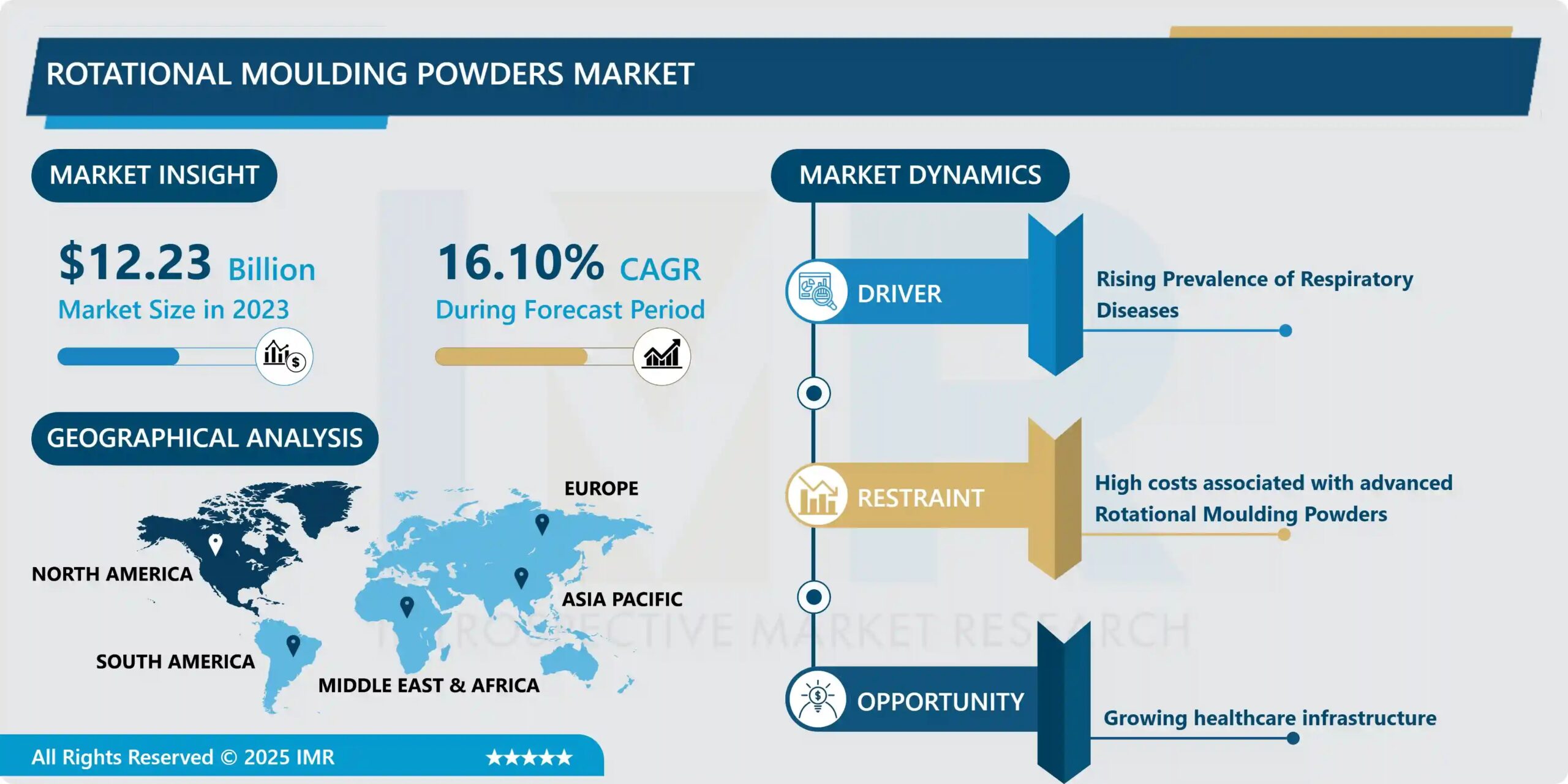
Introspective Market Research (IMR) today released its comprehensive forecast for the global Rotational Moulding Powders Market, projecting a robust growth trajectory through 2032. According to the report, the global market — estimated at USD 12.23 billion in 2023 — is expected to reach USD 63.18 billion by 2032, representing a compound annual growth rate (CAGR) of 16.10% over the 2024–2032 period.
This surge is being driven by multiple converging factors: increasing demand for lightweight, durable and cost-effective plastic products across automotive, consumer goods, and industrial sectors; growing adoption of rotational molding techniques for complex hollow parts; advances in polymer powder formulations; and rising infrastructure, packaging, and water-storage needs globally. IMR’s study provides deep segmentation by powder type, application, and region — giving manufacturers, raw-material suppliers, and product designers critical insight into evolving demand.
Quick Insights
- 2023 Market Size: USD 12.23 billion
- 2032 Forecast Market Size: USD 63.18 billion
- Forecast CAGR (2024–2032): ~ 16.10%
- Major Powder Types Covered: Polyethylene, Polycarbonate, PVC Plastisol
- Key Application Segments: Consumer Goods, Auto Parts, Aircraft Parts, Military Supplies, Others
- Fastest-Growing Regional Market: Asia Pacific — driven by rapid industrial expansion, rising manufacturing, and increasing demand for rotomolded products.
- Core Market Drivers: Lightweight product demand, versatility of rotational molding, growth in automotive and industrial applications, expansion of consumer-goods manufacturing.
Global Market Forecast (2023 → 2032)
| Year | Market Size (USD Billion) |
|---|---|
| 2023 | 12.23 |
| 2032 (Forecast) | 63.18 |
What’s Fueling the Market
IMR’s research identifies several powerful growth engines behind the booming demand for rotational moulding powders:
Demand for Lightweight, Durable Plastic Components: Industries are increasingly replacing metal or bulky materials with rotationally moulded plastic parts — especially in automotive, consumer goods, water tanks, containers, and industrial storage — where strength-to-weight ratio, cost, and durability matter.
Versatility and Cost-Effectiveness of Rotational Molding Process: Rotational molding allows creation of large, hollow, seamless products in a single molding cycle with minimal waste. The powder form offers efficiency in processing, consistent wall-thickness, and flexibility to meet diverse application requirements.
Expanding Industrial, Infrastructure & Packaging Needs Globally: Rapid urbanization, growth in manufacturing, expanding demand for water/storage tanks, containers, and packaging — particularly in emerging economies — is increasing demand for rotomolded products, hence powders.
Advancements in Polymer Powder Technology: Innovations in powder formulations (PE, polycarbonate, PVC plastisol), better material properties (durability, chemical/UV resistance), and enhanced molding technologies are enabling broader adoption across high-demand sectors.
What Opportunities and Trends Are Emerging?
Could rotational moulding powders become the backbone of lightweight, sustainable manufacturing globally?
With increasing emphasis on fuel-efficiency (in automotive), recyclable and lightweight materials (in consumer goods), and cost-effective plastic solutions (in infrastructure, storage, packaging), rotational moulding powders stand out as a critical enabler. As polymer science advances and demand scales, this market could become a cornerstone for a new generation of durable, lightweight, and affordable products worldwide.
Is Asia Pacific set to redefine global volume consumption and production?
Given rapid industrial growth, expanding manufacturing capabilities, increasing infrastructure demand, and rising consumption across multiple end-use industries — Asia Pacific is poised not just for strong growth, but to become the largest global production and consumption hub for rotational moulding powders.
Expert Commentary
“Rotational moulding powders are fast evolving from niche raw-materials to strategic enablers of global manufacturing,” said Dr. Kavita Sharma, Principal Consultant at Introspective Market Research. “The convergence of demand for lightweight, cost-efficient products, expansion of automotive and consumer-goods sectors, and advances in polymer technology is driving a structural shift. Suppliers that invest in high-quality powder production, regional supply-chain expansion, and material innovation will lead the next wave of growth — especially as rotomolding penetrates new industries like aerospace, industrial storage, and advanced consumer goods.”
Regional & Segmentation Analysis
Asia Pacific: Expected to be the fastest-growing and highest-volume region — powered by booming manufacturing, infrastructure growth, increasing plastic consumption, and expanding auto & consumer-goods industries.
North America & Europe: Continue to contribute substantially, supported by strong industrial base, mature automotive and consumer-goods sectors, demand for high-performance plastics, and adoption of advanced rotational molding techniques.
By Powder Type:
Polyethylene (PE): A leading segment due to versatility, cost-effectiveness, and widespread use in tanks, containers, consumer goods.
PVC Plastisol & Polycarbonate Powders: Gaining traction for specialized applications requiring durability, chemical/UV resistance, and structural integrity, especially in automotive, industrial and outdoor products.
By Application:
Consumer Goods & Containers/Tanks: High demand for storage tanks, containers, water tanks, household items, consumer-plastic goods — leveraging rotomolding’s ability to produce large, seamless hollow parts cost-effectively.
Automotive & Industrial Parts: Fuel tanks, automotive housings, industrial containers, enclosures — where durability, lightweight, and cost matter — remain a major end-use segment.
Specialty & Niche Uses (Aerospace, Military, Water/Fuel Storage, Large Tanks): As material and processing technologies evolve, there is rising adoption in more stringent applications requiring performance and reliability.
Recent Breakthroughs & Key Industry Movements
Manufacturers continue to refine polymer powder formulations — improving strength, durability, UV and chemical resistance — allowing rotomolded products to enter previously metal-dominated applications (like automotive, industrial tanks, aerospace components).
Growing interest in recyclable and lighter-weight powders is aligning with global sustainability and regulatory trends — encouraging substitution of heavy materials with rotomolded plastic alternatives.
Expansion of rotomolding capabilities into emerging markets, particularly in Asia Pacific, where manufacturing infrastructure is rapidly scaling and demand for cost-effective, versatile plastic solutions is rising sharply.
Cost Pressures & Strategies to Maintain Cost Efficiency
While the outlook is optimistic, the rotational moulding powders market faces several cost and supply-chain pressures:
Raw-Material Price Volatility: Fluctuating prices of base polymers (e.g., polyethylene, PVC, polycarbonate) impact powder costs — affecting margins, especially for commodity-grade powders.
Energy and Processing Costs: Manufacturing high-quality powders with consistent properties, uniform granularity, and purity requires significant energy and quality control — increasing production cost.
Regulatory & Environmental Compliance: As governments tighten environmental regulations and plastic-waste norms, producers may need to invest in sustainable/responsive practices, recycling, waste-management — adding overhead.
Logistics & Supply-Chain Stability: Global distribution, storage, transport of powder materials (especially across regions) adds to cost and risk due to handling requirements and quality maintenance.
How to Maintain Cost Efficiency:
Scale Production & Vertical Integration: Producers investing in large-scale powder production facilities and integrated supply-chain can benefit from economies of scale and reduce per-unit cost.
Material Optimization & R&D: Develop optimized polymer blends, recycled resin-based powders, and high-efficiency formulations to reduce raw-material cost while maintaining performance.
Regional Manufacturing Hubs: Establish production facilities closer to demand centers (e.g., Asia-Pacific) to reduce transport, logistics, and import-duty costs.
Sustainable/Recycle-Friendly Polymers: Incorporate recycled or lower-carbon footprint resins to address regulatory compliance and appeal to eco-conscious buyers — potentially unlocking price premiums.
Process Efficiency & Waste Reduction: Use improved rotational molding techniques, precise powder dosing, consistent quality control to reduce scrap, energy usage, and waste.
Why This Matters
Rotational moulding powders are fast becoming a linchpin in global manufacturing — enabling the production of lightweight, cost-effective, durable plastic parts across a wide spectrum of industries: automotive, consumer goods, water & storage tanks, industrial containers, and more.
As global demand for affordable, durable, and versatile plastic solutions grows — especially in emerging economies — rotomolding powders offer an efficient, scalable, and flexible solution to meet that demand. For polymer producers, molding companies, OEMs, and investors, this presents a substantial opportunity to ride a high-growth wave, driven by material innovation, industrial expansion, and shifting global manufacturing strategies.
Download & Connect
To access a free sample of our full Rotational Moulding Powders Market Report — including detailed regional breakdowns, segment forecasts, competitive landscape analysis, material-price sensitivity models, and opportunity heat-maps — click: Download Sample
About Introspective Market Research
Introspective Market Research (IMR) is a global market-intelligence firm specializing in advanced materials, plastics, chemicals, industrial polymers, and manufacturing technologies. Our analysts deliver rigorous data-driven market forecasts, actionable strategic analysis, competitive landscaping, and bespoke advisory to help clients navigate evolving markets and capture growth opportunities.
Contact:
Introspective Market Research
Phone: +91 91753-37569.
Email: info@introspectivemarketresearch.com