



Diagnostic Imaging Market Set to Accelerate to $43.43 Billion by 2032, Driven by Chronic Disease Surge & Digital Transformation.
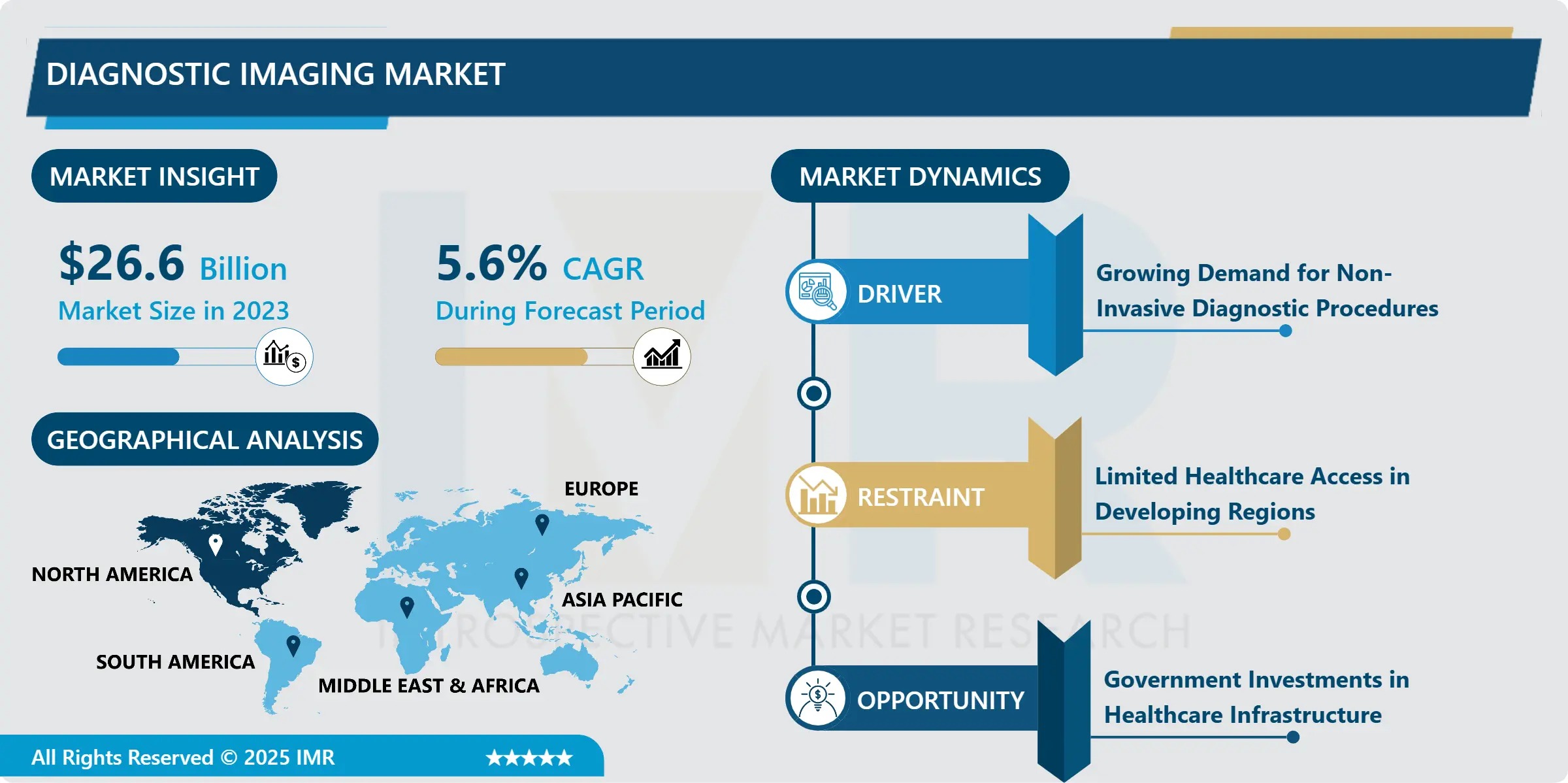
The Diagnostic Imaging Market, a cornerstone of modern medicine encompassing technologies like X-ray, MRI, and CT, is projected to reach a valuation of USD 43.43 Billion by 2032, expanding from USD 26.60 Billion in 2023. This robust growth trajectory is underpinned by a stable Compound Annual Growth Rate (CAGR) of 5.60% over the forecast period from 2024 to 2032.
The market’s primary growth catalysts are twofold: the imperative for early and accurate diagnosis in an aging global population, and the rapid integration of artificial intelligence (AI) and machine learning (ML) into imaging workflows. These innovations are not only enhancing diagnostic accuracy but are also driving the shift toward highly efficient, non-invasive imaging solutions.
Quick Insights: Diagnostic Imaging Market at a Glance
Market Value (2023): USD 26.60 Billion
Market Forecast (2032): USD 43.43 Billion
Projected CAGR (2024-2032): 5.60%
Dominant Product Segment: X-ray imaging, favored for its cost-efficiency and wide-ranging accessibility in primary diagnostics.
Leading Application Area: Cardiology, driving demand for advanced non-invasive methods in cardiovascular disease detection.
Top Regional Market: North America, dominating the market due to its mature healthcare infrastructure, significant R&D investment, and high adoption rate of sophisticated imaging equipment.
Key Growth Driver: Increasing global incidence of chronic diseases, including cancer and cardiovascular conditions.
Market Innovators: GE Healthcare, Siemens Healthineers, and Philips Healthcare are leading the technological disruption.
Data Snapshot: Global Diagnostic Imaging Market Revenue Breakdown
The report provides a detailed breakdown of the market’s financial evolution across the forecast timeline:
| Global Diagnostic Imaging Market | |
| Base Year: | 2023 |
| Forecast Period: | 2024-2032 |
| Historical Data: | 2017 to 2023 |
| Market Size in 2023: | USD 26.60 Billion |
| Forecast Period 2024-32 CAGR: | 5.60% |
| Market Size in 2032: | USD 43.43 Billion |
What Breakthroughs and Trends are Reshaping the Global Diagnostic Imaging Opportunity?
The competitive landscape is being redefined by a seismic shift toward intelligent, portable, and patient-centric imaging. One of the most significant opportunities lies in the convergence of diagnostics and digital health. The report highlights two compelling trends:
Non-Invasive and Portable Solutions: Demand for highly detailed yet non-invasive modalities, particularly MRI and Ultrasound, is skyrocketing. Furthermore, the push for Point-of-Care (PoC) imaging—which utilizes portable devices—is creating lucrative avenues, especially in urgent care, remote settings, and developing economies where rapid diagnosis is crucial.
Tele-Radiology and AI Integration: The integration of telemedicine and distant healthcare services is allowing clinicians to consult with specialists and transmit high-resolution images across vast geographical distances. AI and ML algorithms are now being used to triage scans, automate measurements, and assist in identifying subtle disease patterns, transforming the complex process of image analysis and interpretation into a more efficient, high-throughput service.
Dr. Elara Vance, Principal Consultant at Introspective Market Research, commented on the market evolution:
“The Diagnostic Imaging Market is at an inflection point. It is no longer just about hardware; it’s about intelligent systems. The fusion of AI with established modalities is fundamentally changing patient care, moving us from reactive diagnosis to proactive precision medicine. We are seeing major players invest heavily in high-resolution, low-dose imaging solutions that drastically reduce patient risk while simultaneously boosting clinical efficiency. This technological leap is critical for managing the global burden of chronic diseases.”
Segmentation and Regional Dynamics: The Drive for Digitization
The segmentation analysis underscores the market’s foundational reliance on widely accessible technologies while pinpointing future growth areas:
Product Segmentation: The X-ray segment retains the largest market share due to its established efficacy, accessibility, and lower cost base. However, advanced modalities like MRI and CT are witnessing accelerated adoption, particularly in specialty applications like Neurology and Oncology, driven by the need for superior soft-tissue contrast and detailed staging information.
Application Segmentation: The Cardiology segment currently holds the largest share, leveraging imaging for the early detection and monitoring of coronary artery disease and other structural heart conditions. The Oncology and Neurology segments remain key accelerators as imaging plays an indispensable role in tumor detection, monitoring, and stroke management.
Regional Analysis: North America remains the dominant global leader, largely owing to its sophisticated and well-funded healthcare ecosystem, which readily adopts cutting-edge systems. However, the Asia-Pacific region is identified as the fastest-growing market, presenting immense opportunities. Government initiatives to upgrade public healthcare infrastructure, rising health awareness, and increasing investments from global manufacturers are collectively accelerating the deployment of advanced diagnostic imaging equipment across countries like China and India.
Navigating Cost Pressures and Breakthrough Innovations
To address persistent cost pressures in healthcare, manufacturers are focusing on creating systems that are not only technologically superior but also economically viable and efficient.
Cost Efficiency and Benefits: The shift from analog to Digital Imaging is central to cost management. Digital systems eliminate recurring film costs, reduce the need for physical storage, and facilitate faster image sharing and consultation (tele-radiology), all of which contribute to reduced operational expenses. Portable and compact diagnostic tools also offer significant cost benefits by enabling procedures outside expensive hospital settings, increasing patient throughput, and minimizing the length of hospital stays through rapid diagnosis.
Latest Breakthroughs from Key Companies:
Leading companies such as Siemens Healthineers, GE Healthcare, and Philips Healthcare are spearheading innovation by focusing on:
AI-Powered Workflows: Developing algorithms that automatically generate preliminary reports, quantify disease progression, and reduce reading time for radiologists, thereby optimizing efficiency.
Low-Dose CT and MRI: Releasing new generations of equipment that offer ultra-low-radiation dose capabilities in CT scans and rapid scanning protocols for MRI, significantly improving patient safety and comfort.
Integrated Solutions: Creating integrated diagnostic pathways that link imaging data with patient health records, enabling physicians to move toward highly personalized treatment regimens.
About Introspective Market Research
Introspective Market Research (IMR) is a visionary consulting and market research firm that provides bespoke research, strategic advice, and actionable intelligence globally. Driven by a commitment to data integrity and strategic excellence, IMR equips clients with the precise insights required to navigate complex market dynamics and achieve sustainable growth.
Download the Full Report and Schedule a Consultation
Access the detailed segmentation analysis, competitive intelligence, and growth forecasts within the full Diagnostic Imaging Market report.
CONTACT INFORMATION
Introspective Market Research
Phone: +91 91753-37569.
Email: sales@introspectivemarketresearch.com
Website: https://introspectivemarketresearch.com