





Glutaraldehyde Market Poised for Steady Expansion, Projected to Reach USD 769.65 Million by 2032
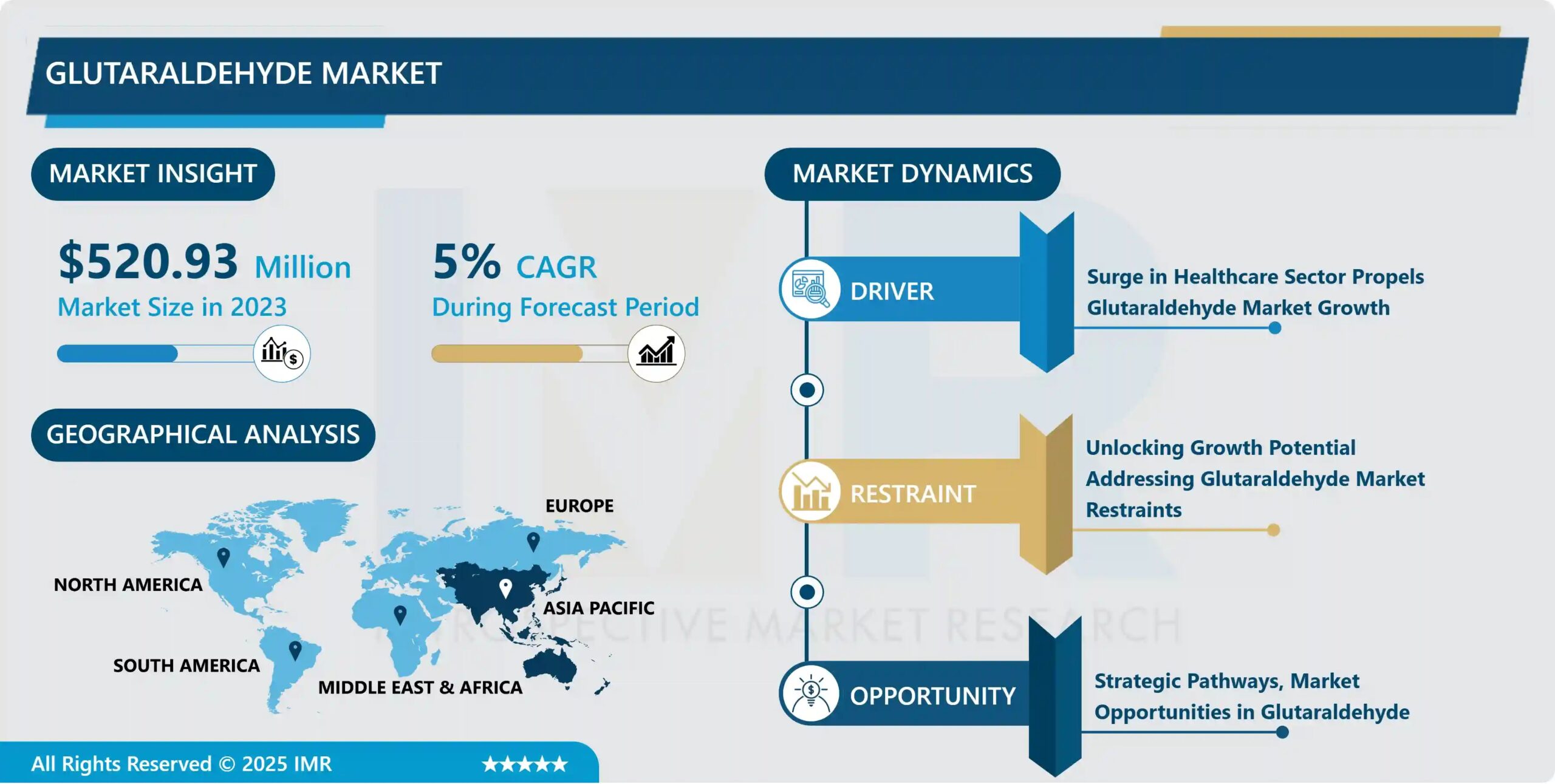
The global Glutaraldehyde Market, valued at USD 520.93 million in 2023, is on track to reach USD 769.65 million by 2032, growing at a compound annual growth rate (CAGR) of 5% from 2024 to 2032, according to the latest in-depth analysis by Introspective Market Research. Glutaraldehyde — a versatile, high-efficacy biocide and cross-linking agent — continues to serve as a backbone chemical across critical industries, from sterilization of surgical instruments to microbial control in industrial water systems and enhanced oil recovery operations.
The market’s growth is being propelled by tightening global infection control mandates, expanding industrial water infrastructure, and rising exploration activity in microbial-prone oilfields. Yet, emerging regulatory scrutiny and the industry-wide shift toward greener alternatives pose long-term challenges—spurring innovation in safer formulations and process optimization.
Quick Insights: Glutaraldehyde Market at a Glance
- 2023 Market Size: USD 520.93 Million
- 2032 Projected Value: USD 769.65 Million
- CAGR (2024–2032): 5%
- Dominant Product Segment: Glutaraldehyde 25% (driven by healthcare disinfection and water treatment applications)
- Largest Application Segment in 2023: Water Treatment
- Fastest-Growing Region: Asia Pacific (expected to lead through 2032 on account of industrialization, healthcare expansion, and tanning sector growth)
- Top Market Players: BASF SE (Germany), LANXESS (Germany), Neogen Corporation (U.S.), ACURO ORGANICS LIMITED (India), Fengchen Group Co., Ltd (China)
- Key End-Use Industries: Healthcare, Water Treatment, Oil & Gas, Agriculture, Leather Tanning, Cosmetics
Why Is Glutaraldehyde Still Indispensable—Even as Alternatives Emerge?
Despite growing pressure to replace traditional biocides with eco-friendly substitutes, glutaraldehyde remains a first-line solution in high-stakes environments where reliability and broad-spectrum efficacy are non-negotiable. Its unique ability to cross-link proteins—rapidly inactivating bacteria, viruses, spores, and fungi—has made it a gold standard in cold sterilization for heat-sensitive medical devices such as endoscopes and respiratory equipment.
Moreover, in industrial settings—from offshore drilling rigs to municipal cooling towers—glutaraldehyde delivers unmatched cost-efficiency in controlling sulfate-reducing bacteria (SRB) and biofilm formation. Its dual utility as both a biocide and cross-linker further embeds it in applications spanning paper manufacturing, textile finishing, and animal feed preservation.
“Glutaraldehyde isn’t just surviving—it’s evolving,” says Dr. Arvind Mehta, Principal Consultant, Chemicals & Materials Practice at Introspective Market Research.
“What we’re witnessing is a maturing market—no longer reliant solely on volume growth, but on value-added innovation. Manufacturers are reformulating for reduced volatility, lower irritation potential, and extended activity in high-salinity or high-temperature environments. At the same time, APAC’s explosive demand in agri-veterinary and small-hospital sanitation is balancing out slowdowns in regulated Western markets. This duality defines the next decade of glutaraldehyde.”
Regional Spotlight: Asia Pacific Emerges as the Growth Epicenter
While Europe and North America remain mature markets—anchored by stringent hospital accreditation standards (e.g., CDC, ECRI, and EU Medical Device Regulation)—Asia Pacific is set to dominate the forecast period, driven by:
- Rapid expansion of tier-2 and tier-3 hospitals and diagnostic labs in India, Indonesia, and Vietnam
- Government-led water infrastructure projects (e.g., India’s Jal Jeevan Mission, China’s Sponge City Initiative) requiring robust microbial control
- Booming leather and textile exports from Bangladesh, Pakistan, and Myanmar, where glutaraldehyde-based tanning improves hide stability and reduces chrome dependency
- Surge in onshore and offshore oilfield development in Southeast Asia, where microbial-induced corrosion (MIC) mitigation is mission-critical
In contrast, North America’s growth is being fueled by aging infrastructure upgrades—especially in cooling water systems—and rising adoption in veterinary disinfection and farm biosecurity protocols. Europe, though highly regulated (notably under REACH), maintains steady demand, particularly in Germany and Italy’s precision engineering and medical device manufacturing clusters.
Market Segmentation Deep Dive
By Product Type
- Glutaraldehyde 25%: Dominates the market, preferred for healthcare sterilization and municipal/industrial water treatment due to optimal balance of efficacy, safety, and handling stability.
- Glutaraldehyde 50%: Gaining traction in oilfield biocides and leather tanning—where higher potency is required to penetrate biofilms or stabilize collagen matrices.
By Application
| Water Treatment | Regulatory mandates (EPA, WHO), biofouling in power/chemical plants, cooling tower hygiene | Largest segment |
| Healthcare | Post-pandemic infection control focus, rise in minimally invasive surgeries, endoscope reprocessing | High-growth, high-value |
| Oil & Gas | MIC mitigation in pipelines, fracturing fluid preservation, offshore asset integrity | Steady, project-driven |
| Leather Tanning | Chrome-free tanning initiatives, demand for eco-processed leather in EU export markets | Emerging in APAC |
| Agriculture & Feed | Feed spoilage prevention, farm equipment sanitation, foot-and-mouth disease containment | Niche but expanding |
Innovation & Cost-Efficiency: How Industry Leaders Are Adapting
Leading players are investing in next-generation stabilized glutaraldehyde formulations to reduce occupational hazards (e.g., vapor suppression, pH buffering) while enhancing shelf life and compatibility with automated reprocessing systems.
Recent developments include:
- LANXESS launching a low-emission, buffered 28% glutaraldehyde concentrate for dialysis center disinfection—reducing staff exposure and rinse cycles.
- Neogen Corporation integrating glutaraldehyde-based surface sanitizers into its Virkon® portfolio for poultry farm biosecurity, cutting pathogen load by >99.99% in field trials.
- ACURO ORGANICS and Fengchen Group scaling up in-situ synthesis to reduce logistics risk and raw material volatility—critical for cost-sensitive emerging markets.
Cost Optimization Strategies Gaining Traction:
- Blended biocides: Combining glutaraldehyde with quaternary ammonium compounds (QACs) or DBNPA for synergistic effect—lowering required dosage.
- On-site generation systems: Pilot deployments in large refineries and hospitals to minimize transport, storage, and waste handling costs.
- Closed-loop reprocessing: In endoscopy units, advanced AERs (Automated Endoscope Reprocessors) now recover and reuse up to 60% of glutaraldehyde solution per cycle.
Explore the Full Market Potential
For stakeholders—chemical distributors, OEM sterilization solution providers, water treatment engineers, and regulatory strategists—understanding glutaraldehyde’s evolving risk-reward profile is essential. The Glutaraldehyde Market Report (2024–2032) by Introspective Market Research delivers:
- 200+ pages of granular analysis across 7 global regions and 18+ countries
- Product-wise pricing trends (USD/kg) and margin benchmarks
- Regulatory tracking: EPA, REACH, FIFRA, and China’s new chemical inventory (IECSC) updates
- Company profiling with SWOT, M&A activity, and R&D pipeline mapping
- Customizable forecasting (by concentration, application, container size, or end-user tier)
Download a Free Sample Report:
https://introspectivemarketresearch.com/reports/glutaraldehyde-market/
About Introspective Market Research
Introspective Market Research is a globally recognized provider of strategic business intelligence, serving Fortune 500 clients, investors, and policy institutions across healthcare, chemicals, advanced materials, and sustainability sectors. With a team of 120+ domain experts and a rigorous mixed-methodology approach—combining primary interviews, patent mining, regulatory forensics, and real-world usage analytics—we deliver actionable foresight, not just data.
Our mission: To turn complexity into clarity—and insight into impact.
Media Contact
Priya Deshmukh
Senior Content & Communications Lead
Introspective Market Research
info@introspectivemarketresearch.com
Phone:- +91 91753-37569.