



Global Lyophilized Product Market Set to Surpass USD 1,000.2 Billion by 2032, Fueled by Biologics Boom, Vaccine Innovation, and Cold-Chain Independence.
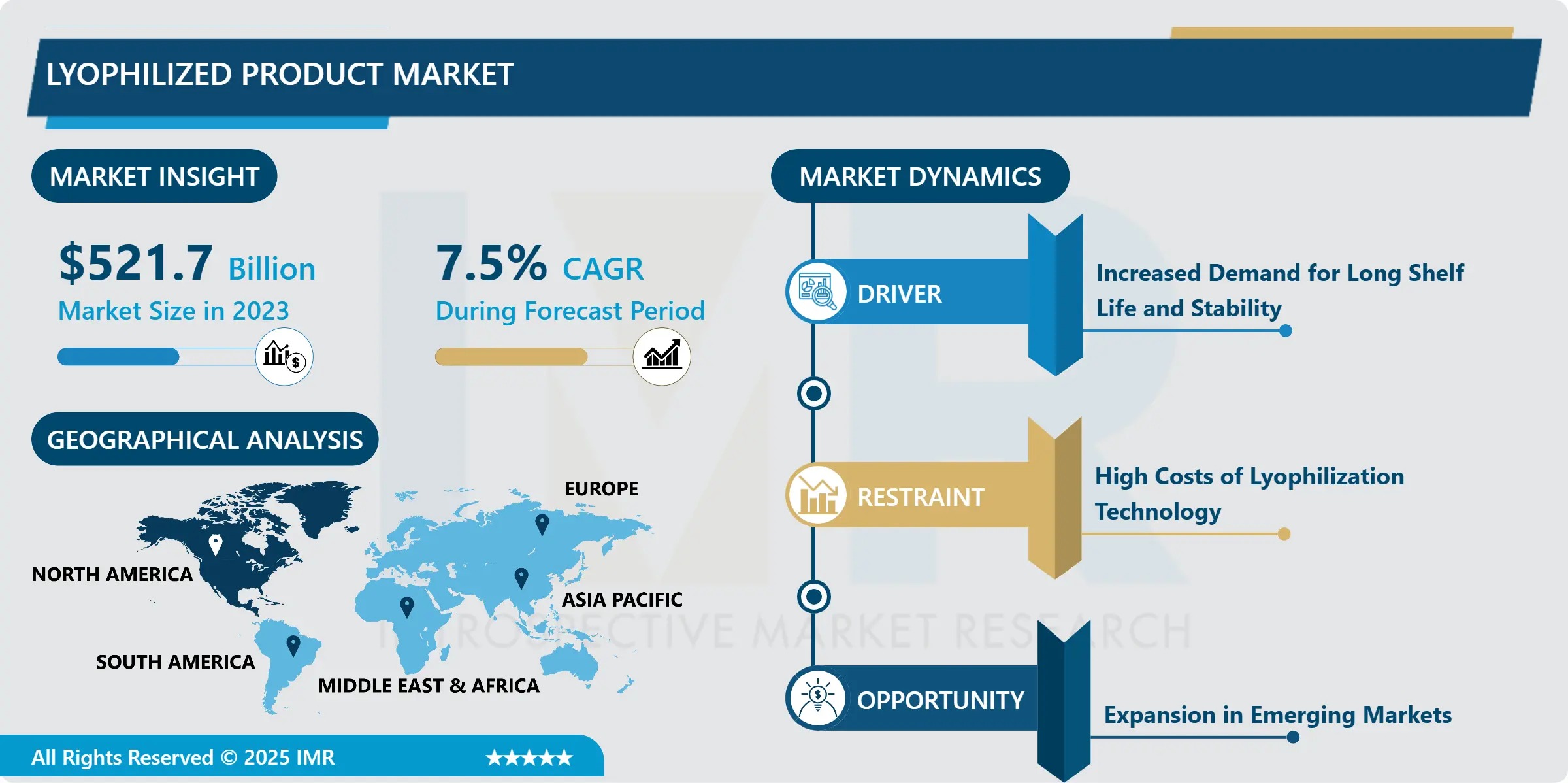
The Lyophilized Product Market is entering a transformative growth phase, propelled by the global surge in biologics development, demand for thermostable vaccines, and the critical need for supply-chain-resilient pharmaceuticals. According to the latest analysis by Introspective Market Research, the market—valued at USD 521.7 Billion in 2023—is forecast to reach USD 1,000.2 Billion by 2032, expanding at a robust compound annual growth rate (CAGR) of 7.5% from 2024 to 2032.
Lyophilization—also known as freeze-drying—is a sophisticated dehydration process that preserves bioactive molecules by removing water via sublimation under vacuum after deep freezing. This method preserves structural integrity, potency, and shelf-life of sensitive therapeutics, enabling long-term ambient-temperature storage and eliminating dependence on ultra-cold chain logistics. With over 70% of new FDA-approved drugs being biologics—including monoclonal antibodies, peptides, mRNA constructs, and cell & gene therapies—the imperative for lyophilized stabilization has never been greater.
From pandemic-ready vaccines to next-generation oncology biologics and point-of-care diagnostics, lyophilized products are now foundational to modern healthcare infrastructure—especially in resource-constrained and emerging regions where refrigeration access remains inconsistent.
Quick Insights: By the Numbers
- 2023 Market Size: USD 521.7 Billion
- 2032 Projected Value: USD 1,000.2 Billion
- CAGR (2024–2032): 7.5%
- Dominant Product Type: Lyophilized Injectable (accounts for largest share due to stability needs of parenteral biologics, peptides, and high-potency APIs)
- Largest Application Segment: Pharmaceuticals (driven by biologics, oncology agents, and complex injectables requiring shelf-life extension)
- Top End-User: Pharmaceutical & Biotechnology Companies (R&D and commercial manufacturing dominate demand)
- Leading Region: North America (~41% market share in 2023), anchored by U.S. leadership in biopharma innovation and FDA-aligned lyophilization standards
- Key Players: Pfizer Inc. (USA), Eli Lilly and Company (USA), Merck & Co., Inc. (USA), Novartis AG (Switzerland), Baxter International Inc. (USA), Lonza Group (Switzerland), Samsung Biologics (South Korea), Amgen Inc. (USA), Fujifilm Diosynth Biotechnologies (Japan), Takeda Pharmaceutical (Japan), AbbVie Inc. (USA), Sandoz International GmbH (Switzerland)
Opportunity Spotlight: Can Advanced Process Analytical Technology (PAT) and Continuous Lyophilization Unlock Scalability for Next-Gen Biologics and mRNA Platforms?
Two converging innovations are redefining the lyophilization landscape: real-time process control and modular, continuous freeze-drying. Traditional batch lyophilization—often taking 24–72 hours per cycle—is increasingly seen as a bottleneck in agile biomanufacturing. Next-generation systems integrating tunable microwave-assisted drying, smart vial sensors, and AI-driven endpoint prediction are cutting cycle times by up to 50% while improving cake homogeneity and reconstitution speed.
Crucially, lyophilized mRNA vaccines represent a paradigm shift. Following pioneering work on thermostable formulations for rabies and RSV, companies like Moderna and CureVac (in partnership with LyoTech Labs) have demonstrated mRNA stability at 25°C for >6 months—potentially eliminating the −70°C cold chain once and for all. This breakthrough is catalyzing investments in decentralized fill-finish networks across Africa, Southeast Asia, and Latin America.
As personalized medicine advances—particularly autologous cell therapies with narrow dosing windows—demand is surging for on-demand lyophilization suites embedded within hospital GMP facilities. The ability to freeze-dry patient-specific doses on-site promises to slash logistics complexity and enable same-day reconstitution.
“Lyophilization is no longer just a preservation step—it’s a strategic enabler of equitable access,” says Dr. Priya Desai, Principal Consultant, Advanced Drug Delivery & Bioprocessing Practice at Introspective Market Research. “The real value shift lies in designing for lyophilization from molecule inception. Companies embedding excipient screening, cake morphology modeling, and scalability assessment early in development are seeing 30–40% faster tech transfer and 22% lower COGS. In the era of platform biologics, freeze-drying isn’t optional—it’s integral to commercial viability.”
Regional Leadership & Strategic Segmentation Breakdown
North America remains the largest market, with the U.S. driving over 80% of regional demand. Strong FDA guidance (e.g., Chemistry, Manufacturing, and Controls for lyophilized products), high biologics pipeline density, and robust CDMO infrastructure (e.g., Catalent, Recipharm, Thermo Fisher) sustain leadership. The rise of lyo-ready biosimilars—particularly in oncology and immunology—is accelerating adoption.
Europe ranks second, led by Germany, Switzerland, and the UK—home to global lyophilization equipment leaders (SP Scientific, GEA, BOC Edwards) and innovators in container-closure systems (Schott, Gerresheimer). EU regulatory harmonization under EMA’s Guideline on Freeze-Drying has streamlined approvals for novel formulations.
The Asia Pacific region is the fastest-growing (CAGR >8.7%), with China and India scaling domestic lyophilization capacity under national biologics self-reliance initiatives. South Korea’s Bio-Vision 2030 and Japan’s METI grants are accelerating investment in continuous lyo platforms. Notably, ASEAN nations are prioritizing lyophilized vaccine production to meet WHO prequalification standards—creating a $4.3B regional opportunity by 2028.
By Type, Lyophilized Injectables lead due to dominance of parenteral biologics:
- Lyophilized Vaccines are the fastest-growing subsegment—driven by WHO’s Expanded Program on Immunization (EPI) and demand for thermostable formulations (e.g., measles-rubella, inactivated polio).
- Lyophilized Biologics (mAbs, fusion proteins, enzymes) are expanding rapidly, with oncology and rare disease therapies representing 65% of pipeline candidates requiring freeze-drying.
By Packaging, vials remain standard, but prefilled syringes with integrated lyo-cakes (e.g., West’s FluroTec®-coated EZ-fill®) are gaining traction for patient self-administration—reducing reconstitution errors and improving compliance.
Innovation Pipeline: Breakthroughs Enhancing Stability, Speed, and Accessibility
Industry leaders are advancing next-generation platforms:
- Pfizer launched Lyostep™, a proprietary excipient system enabling rapid reconstitution (<10 sec) for high-viscosity mAbs—now deployed in its Phase III IL-23 inhibitor for psoriasis.
- Eli Lilly completed tech transfer of its dual-chamber Lyoprime™ autoinjector for tirzepatide biosimilars, eliminating reconstitution entirely—cutting administration time by 70%.
- Samsung Biologics inaugurated its LyoHub 2.0 facility in Incheon—featuring 12 continuous lyophilizers with real-time moisture monitoring—boosting capacity by 3× and reducing energy use by 35%.
- Fujifilm Diosynth partnered with CEPI to develop a platform for lyophilized mRNA-LNP vaccines, achieving 12-month stability at 4–8°C—critical for global pandemic preparedness.
Cost-Efficiency Strategies: Overcoming High CAPEX and Energy Intensity
Lyophilization accounts for up to 35% of total manufacturing cost for biologics—driven by energy-intensive vacuum systems and extended batch cycles. To optimize ROI:
- Process Intensification: Adoption of manifold loading (20% more vials/batch) and smart ramp-hold algorithms reduces cycle time and utility consumption.
- Hybrid Drying: Combining convective pre-drying with lyophilization for robust molecules (e.g., certain enzymes, diagnostics) cuts energy use by 50%.
- In-line Analytics: NIR and Raman spectroscopy for endpoint detection prevent over-drying—preserving potency while shortening cycles.
- Renewable Integration: Lyophilization suites powered by onsite solar + battery storage (e.g., Lonza’s Visp plant) lower carbon intensity and hedge against grid volatility.
The strategic payoff? Each 1-hour reduction in lyophilization cycle time saves ~USD 18,000–25,000 per commercial batch—translating to >USD 200M annual savings for blockbuster mAbs.
About the Report
Lyophilized Product Market – Growth Analysis & Forecast (2024-2032) offers a comprehensive 310+ page assessment across 5 dimensions:
- Type: Lyophilized Injectable, Bulk Products, Diagnostics, Vaccines, Biologics
- Application: Pharmaceuticals, Biotechnology, Food & Beverages, Diagnostics
- Packaging Type: Vials, Ampoules, Syringes, Others
- End User: Pharmaceutical & Biotech Companies, Hospitals & Clinics, Research Labs
- Region: North America, Europe, APAC, MEA, South America
Includes full profiling of 13 key players, regulatory deep-dives (FDA, EMA, PMDA, NMPA), equipment vendor analysis, and granular 15-year historical & forecast modeling (2017–2032).
Unlock Strategic Foresight for Your Lyophilization Roadmap
To receive a complimentary sample report, Visit:
https://introspectivemarketresearch.com/request/20128
Media Contact:
Sarah Kim
Director of Communications
Introspective Market Research
Email: info@introspectivemarketresearch.com
Phone: +91 91753-37569.
Website: https://introspectivemarketresearch.com
About Introspective Market Research
Introspective Market Research(IMR) is a premier global intelligence provider for the pharmaceutical, biotechnology, and advanced therapeutics sectors. Our team of PhD scientists, former FDA/EMA assessors, and bioprocessing engineers delivers rigorously validated insights that empower innovators to de-risk development, optimize manufacturing, and expand global access. We combine proprietary equipment databases, clinical pipeline tracking, and real-world supply chain analytics to set the benchmark for depth, accuracy, and strategic relevance.